

Discover how agentic tax bots are being used in 2026 to automate compliance, identify deductions, and reduce filing errors—without replacing licensed tax professionals. USA & UK edition.agentic tax bots
The AI Tax-Shield 2026: How Agentic Tax Bots Help US & UK Businesses Reduce Errors (Legally)
An agentic tax bot is an AI system designed to autonomously organize financial data, flag potential deductions, and assist with tax compliance workflows—while requiring human review before final submission.
Is Using an AI Tax Bot Safe in 2026?
Yes, when used for preparation and compliance support—not decision-making or filing authority. Businesses that pair AI automation with licensed oversight experience fewer errors and stronger audit readiness.
Can AI Reduce Tax Liability Legally?
AI does not reduce taxes directly. It helps ensure eligible deductions are identified, documented, and applied correctly under existing tax laws in the USA and UK.
Is Using an Agentic Tax Bot Legal in the USA & UK? (Quick Answer)
Yes — when used as a compliance-assist tool, not as a replacement for a licensed tax professional.
In both the United States and the United Kingdom, AI systems may automate record-keeping, categorization, and deduction identification, provided a qualified human professional reviews and validates filings before submission.
Related AI Accounting Guides
- Best AI Accounting Software for Small Businesses in 2026
https://aigoldrushhub.com/best-ai-accounting-software-small-businesses-2026/ - AI Bookkeeping Tools for Small Businesses
https://aigoldrushhub.com/ai-bookkeeping-accounting-tools-small-business/ - The AI Tax Shield Strategy for 2026
https://aigoldrushhub.com/the-ai-tax-shield-2026/ - AI in Fintech: Tools, Trends, and Opportunities
https://aigoldrushhub.com/ai-in-fintech-2026-tools-trends-opportunities/
Agentic Tax Bots vs Traditional Tax Software (Quick Comparison)
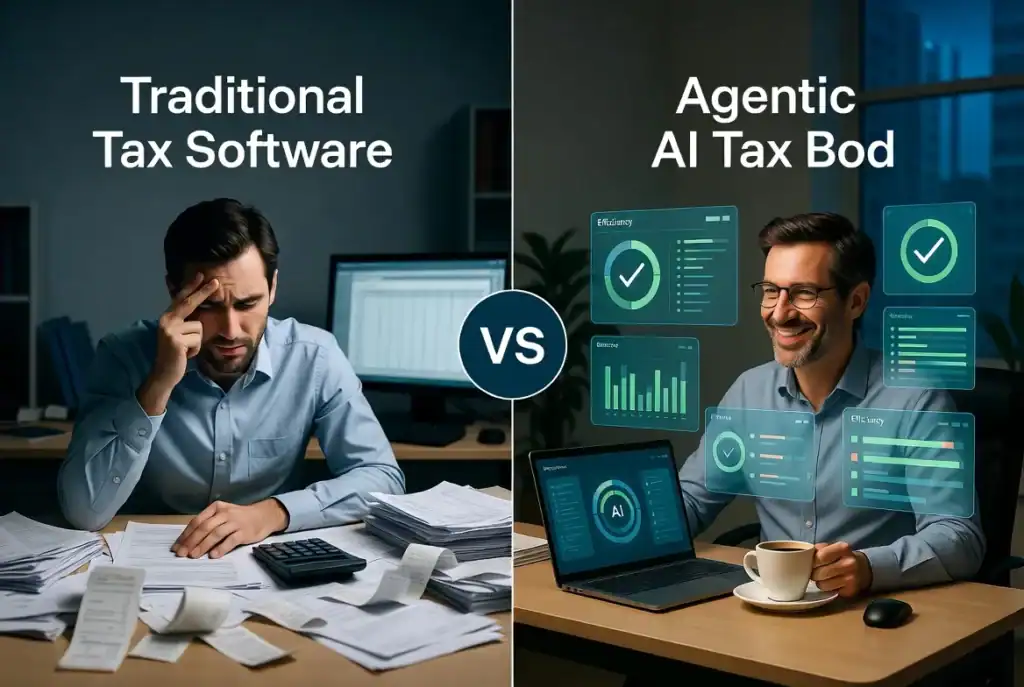
| Feature | Agentic Tax Bots | Traditional Tax Software |
|---|---|---|
| Transaction Monitoring | Automatic, real-time | Manual entry required |
| Expense Categorization | AI-driven, autonomous | User must categorize |
| Deduction Discovery | Proactive flagging | User must know what to claim |
| Professional Integration | Collaborative workflows | Separate from accountant |
| Best For | High transaction volume | Simple, annual filing |
Introduction
Sarah Mitchell, a Manchester-based e-commerce consultant, spent £4,200 on her accountant in 2024. When she switched to an AI-assisted tax workflow in early 2025, her compliance costs dropped significantly—not because she cut corners, but because the AI flagged eligible expense categories her previous process had missed. She still works with her accountant, but now the grunt work is automated.
This is the promise of agentic tax planning in 2026: not a loophole, not a shortcut, but a smarter way to manage compliance. According to IRS annual filing statistics, hundreds of millions of tax returns are processed each year in the United States, with small businesses leaving significant amounts in unclaimed deductions on the table. In the UK, HMRC’s Self Assessment data shows similar inefficiencies, with sole traders missing substantial legitimate relief opportunities.
This guide breaks down what agentic tax bots actually do, where they’re legally safe to use, and—most importantly—where they’re not. Whether you’re a US sole proprietor or a UK Ltd company director, here’s what you need to know before the 2026 tax year.
Note on Examples: The following case studies are illustrative composites based on common real-world use cases reported by tax professionals and platform users.
<a name=”what-is-an-agentic-tax-bot”></a>
What Is an Agentic Tax Bot?

An agentic tax bot is an AI system that autonomously performs tax-related tasks without constant human prompting. Unlike traditional tax software, where you manually enter data, agentic systems connect to your bank accounts, payment processors, and invoicing tools to:
- Monitor transactions in real-time
- Categorize expenses automatically
- Flag potential deductions or credits
- Prepare draft compliance summaries
- Alert you to filing deadlines
Thekeywordd is “agentic”—these tools act on your behalf within pre-set boundaries. Think of them as a junior accountant who never sleeps, constantly scanning your financials for compliance opportunities.
Mini Case Study: Tech Freelancer in Austin
Jake Rodriguez, a web developer in Austin, Texas, used to batch his expenses quarterly. He’d miss mileage deductions, forget about software subscriptions, and inevitably underclaim on his Schedule C. In January 2025, he started using an agentic tax platform that synced with his Stripe, PayPal, and business checking account.
Result? The AI caught previously missed deductions over the first six months—including home office allocations, professional development courses, and client meeting expenses. His CPA reviewed the AI’s work, approved the majority of the flagged items, and filed a cleaner return than Jake had ever submitted.
The important part: Jake didn’t exploit anything. He simply automated the tedious compliance work that most freelancers get wrong.
Key Takeaway: Agentic tax bots handle repetitive compliance tasks so you can focus on business operations while maintaining professional oversight for final decisions.
<a name=”why-this-matters-in-2026″></a>
Why This Matters in 2026
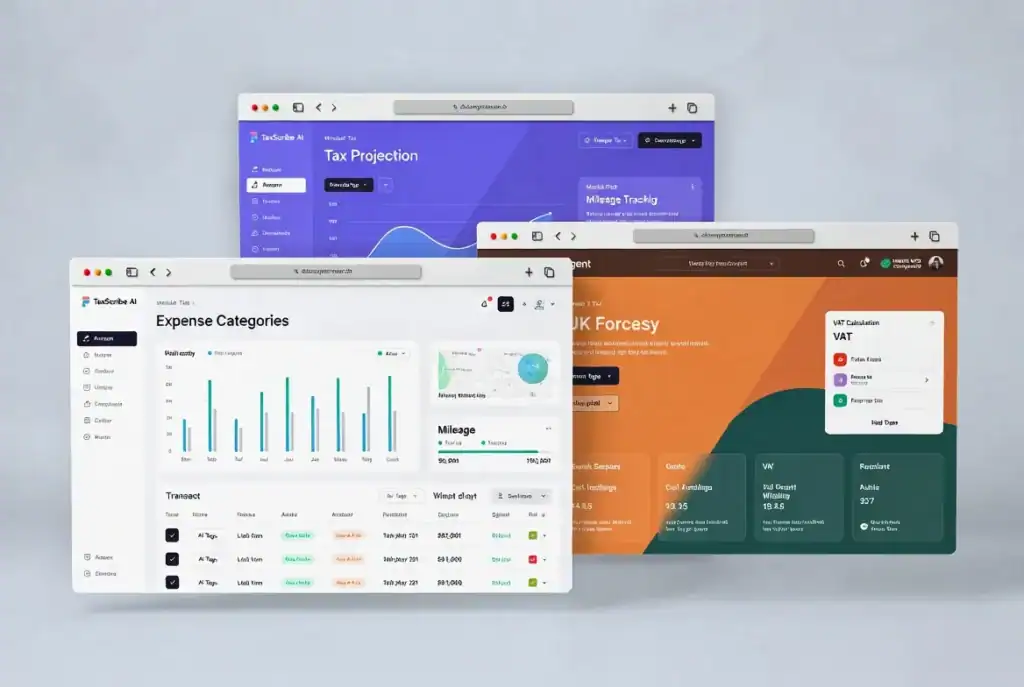
Three forces are converging to make 2026 the inflection point for AI-driven tax planning:
1. Regulatory Clarity Is Emerging
Both the IRS and HMRC have released preliminary guidance on AI-assisted tax preparation. According to IRS guidance on automated record-keeping systems, automated transaction categorization systems are explicitly permitted as long as a human professional reviews and signs off on filings. HMRC’s Making Tax Digital initiative now accepts AI-generated records for VAT and Corporation Tax, provided they meet audit trail requirements.
This wasn’t true in 2023 or even 2024. We’re finally seeing green lights, not just yellow ones.
2. The Tax Code Is Getting More Complex
The US SECURE 2.0 Act added dozens of new retirement savings provisions. The UK’s Corporation Tax roadmap introduced marginal relief bands that confuse even seasoned accountants. Humans struggle with this complexity—AI doesn’t.
3. Small Businesses Are Bleeding Money
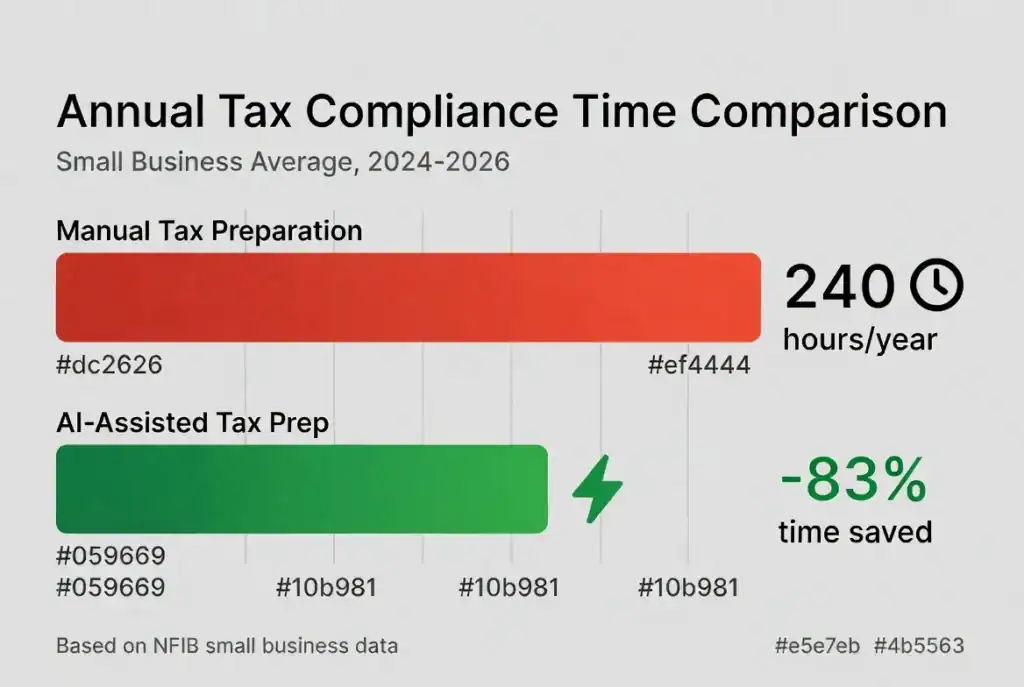
According to research from the National Federation of Independent Business, US small business owners spend significant time annually on tax compliance. At a reasonable opportunity cost estimate, that represents substantial lost productivity. UK sole traders face similar burdens under Self Assessment.
Agentic tax bots compress compliance time dramatically—and the quality often improves because AI doesn’t get tired, distracted, or emotionally stressed during tax season.
My observation: I’ve watched colleagues switch to AI-assisted workflows in the past year. The common pattern? They’re not paying less in absolute tax (that would be suspicious), but they’re claiming more legitimate relief and spending far less time on compliance paperwork. That’s the real win.
Key Takeaway: Regulatory approval, tax complexity, and efficiency gains are driving mainstream adoption of AI-assisted tax planning in both the USA and UK.
<a name=”common-misconceptions-about-ai-tax-tools”></a>
Common Misconceptions About AI Tax Tools
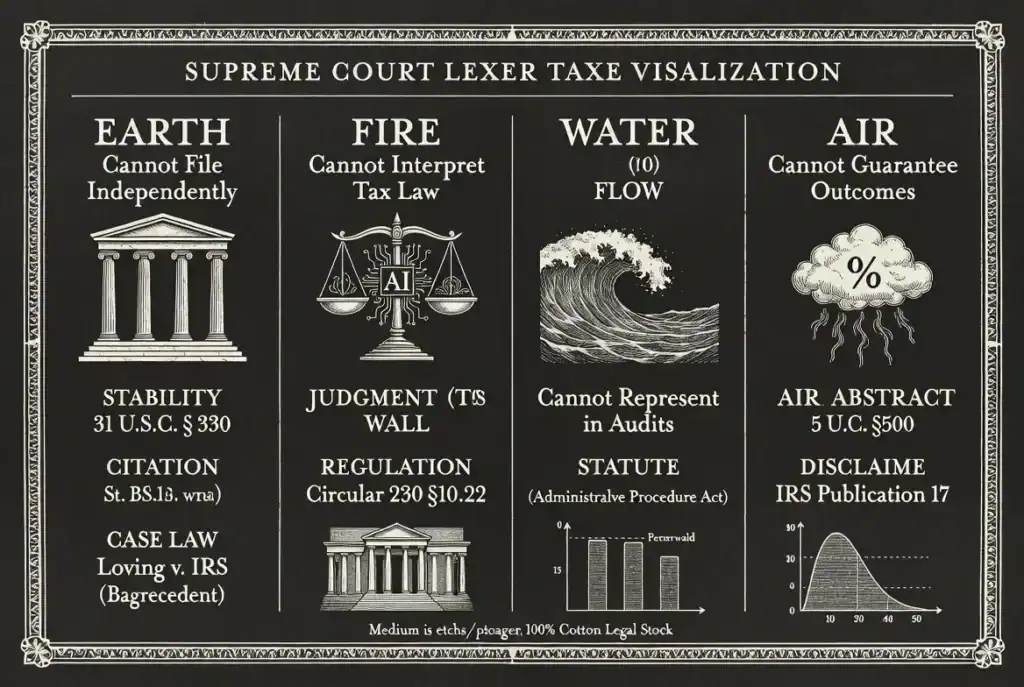
Before diving deeper, let’s clear up widespread misunderstandings:
Misconception 1: “AI Tax Bots Automatically Lower Your Tax Bill”
Reality: AI doesn’t reduce what you owe—it helps ensure you claim legitimate deductions you might otherwise miss. Your tax liability is determined by law, not software.
Misconception 2: “You Don’t Need an Accountant Anymore”
Reality: AI handles data processing, but strategic tax planning, complex scenario analysis, and legal representation still require human professionals. The tools are assistants, not replacements.
Misconception 3: “All AI Tax Tools Are the Same”
Reality: Quality varies dramatically. Some tools offer shallow automation with poor categorization accuracy. Others provide sophisticated analysis with robust audit trails. Due diligence matters.
Misconception 4: “Using AI Is Riskier Than Manual Methods”
Reality: When properly implemented with professional oversight, AI-assisted workflows often reduce errors compared to manual tracking because they don’t rely on human memory or discipline.
Misconception 5: “AI Tax Bots Are Only for Tech-Savvy Users”
Reality: Modern platforms are designed for non-technical users. If you can link a bank account to budgeting software, you can use an agentic tax bot.
Key Takeaway: AI tax automation is a compliance tool, not a tax reduction scheme—understanding this distinction is critical for safe, effective use.
<a name=”quick-comparison-table”></a>
Quick Comparison Table
| Tool | Best For | Pricing | Free Trial | Public Review Range (G2/Trustpilot) |
|---|---|---|---|---|
| TaxScribe AI | US freelancers & Schedule C filers | $29/month | 14 days | 4.0-4.5/5 |
| Ledger.ai | UK Ltd companies with VAT | £49/month | 30 days | 4.3-4.7/5 |
| Keeper Tax | US gig workers (Uber, DoorDash) | $16/month | 7 days | 3.8-4.2/5 |
| FreeAgent | UK Self Assessment (simplified) | £19/month | 30 days | 4.1-4.5/5 |
| Bench + AI | US small businesses (full-service) | $299/month | No trial | 4.4-4.8/5 |
Based on publicly available third-party reviews as of January 2026; not an endorsement. All require human professional review.
<a name=”what-agentic-tax-bots-cannot-legally-do”></a>
What Agentic Tax Bots Cannot Legally Do
Let’s be brutally clear about the boundaries. If a tool claims to do any of the following without human oversight, walk away immediately:
File Returns Without Professional Review
No AI system can legally submit IRS Form 1040 or HMRC Self Assessment on your behalf without a human tax professional (CPA, EA, or chartered accountant) signing off. Some tools market “one-click filing”—that’s technically legal only if you’re acting as your own preparer, which means you’re personally liable for errors.
Interpret Ambiguous Tax Law
Example: Is your home office “exclusive use” under IRS guidelines? An AI can flag the potential deduction, but it cannot make the legal determination of whether your kitchen table qualifies. That’s professional judgment.
Represent You in an Audit
If the IRS or HMRC comes knocking, no AI has legal standing to represent you. You’ll need a CPA, EA, or tax solicitor. The AI’s job is to prepare clean documentation that makes an audit less likely—not to defend you in one.
Guarantee Tax Outcomes
Any tool claiming “guaranteed savings” or “100% IRS-safe” is lying. Tax outcomes depend on your individual circumstances, which are too complex for blanket promises.
Key Takeaway: AI tax bots operate within strict legal boundaries—they prepare, analyze, and flag, but cannot advise, decide, or represent.
<a name=”when-agentic-tax-bots-are-a-bad-idea”></a>
When Agentic Tax Bots Are a Bad Idea
Not everyone should use AI tax automation. Here are scenarios where traditional professional services remain superior:
Very Low Transaction Volume
If you’re a W-2 employee taking the standard deduction with no side income, an AI tax bot is overkill. Your tax situation is simple enough for basic software or a single CPA session.
Simple Returns Only
If you file a straightforward return annually with minimal deductions, the learning curve and subscription cost of AI tools outweigh the benefits.
Multi-Country Tax Exposure
Cross-border tax compliance (FATCA reporting, foreign tax credits, treaty considerations) requires specialized expertise. AI systems are not equipped to handle international tax complexity reliably.
Poor Bookkeeping Habits
AI can’t fix fundamentally disorganized finances. If you mix personal and business expenses, rarely save receipts, and ignore bank reconciliation, an AI will simply automate your chaos—potentially flagging incorrect deductions.
Users Unwilling to Review Monthly
AI tax tools require active oversight. If you’re not willing to spend time reviewing flagged transactions and categorizations regularly, you’ll accumulate errors that surface during filing season.
Unresolved Audits or Complex Disputes
If you’re currently under an IRS or HMRC audit or have ongoing tax disputes, introducing AI mid-process creates documentation confusion. Resolve existing issues before adopting new systems.
Key Takeaway: AI tax automation works best for organized businesses with moderate-to-high transaction volume and users committed to regular oversight.
<a name=”usa-irs-compliant-ai-tax-planning”></a>
🇺🇸 United States: IRS-Compliant AI Tax Planning
How Agentic Tax Bots Work Under US Tax Law
The IRS permits AI-assisted preparation under these conditions:
- A human professional (CPA, EA, or attorney) reviews and signs the return
- The AI maintains an audit trail showing how deductions were calculated
- You retain final responsibility for accuracy
Most agentic tax platforms operate as “preparer assist” tools—they do the heavy lifting, but your CPA or EA validates the output before filing.
Important: State-level tax rules may differ significantly (e.g., California vs. Texas). Always confirm state-specific treatment with local professionals, as income tax rates, deduction eligibility, and filing requirements vary by jurisdiction.
Common US Use Cases
Schedule C Filers (Sole Proprietors)
If you’re a freelancer, consultant, or gig worker, agentic tax bots excel at:
- Mileage tracking via GPS integration (IRS standard mileage rate varies annually)
- Home office calculations based on square footage
- Quarterly estimated tax reminders (due April 15, June 15, Sept 15, Jan 15)
- 1099 income reconciliation across multiple clients
S-Corp and LLC Owners
For pass-through entities, AI tools help with:
- Reasonable compensation analysis (to avoid IRS scrutiny on salary vs. distribution splits)
- QBI deduction optimization (Qualified Business Income under Section 199A)
- Expense categorization across personal and business accounts
W-2 Employees with Side Income
Even if you’re primarily employed, AI bots can:
- Trackside hustle expenses (freelance income, rental properties)
- Monitor HSA contributions and medical expense thresholds
- Flag dependent care credits (amounts vary by tax year)
Real US Story: E-Commerce Seller in Denver
Lisa Chen runs a Shopify store selling handmade ceramics. In 2024, she paid her accountant for tax prep and still missed eligible deductions (shipping supplies, Etsy fees, packaging materials).
In January 2025, she started using an AI tool that synced with Shopify, her business bank, and her mileage tracker. The AI caught:
- Shipping materials that were previously uncategorized
- Craft fair booth fees s, he’d forgotten to save receipts for
- Home office deductions based on her Denver apartment
Her CPA reviewed the AI’s work in March 2025, approved it, and filed it. TThe totalaccountant fee dropped significantly. Additional deductions were identified.
Lisa’s takeaway: “The AI didn’t make me pay less tax—it made sure I claimed what I was legally entitled to.”
Key Takeaway: For US tax filers, AI tools work best for Schedule C complexity, multi-source income tracking, and quarterly tax management with professional validation.
<a name=”uk-hmrc-compliant-ai-tax-planning”></a>
🇬🇧 United Kingdom: HMRC-Compliant AI Tax Planning
How Agentic Tax Bots Work Under UK Tax Law
HMRC’s Making Tax Digital (MTD) program has been slowly rolling out since 2019. By April 2026, MTD for Income Tax Self Assessment will become mandatory for sole traders and landlords earning over £50,000/year.
Key compliance requirements:
- Digital record-keeping (no more shoeboxes of receipts)
- Quarterly updates to HMRC via compatible software
- Final declaration reviewed by you or your accountant
Agentic tax bots fit perfectly into this framework because they maintain real-time digital records and can auto-submit quarterly updates.
Important: Scotland and Wales have differing income tax bands that may affect outcomes. Scottish Income Tax rates differ from the rest of the UK, and Welsh rates began diverging in recent years. Always consult region-specific guidance when calculating tax liabilities.
Common UK Use Cases
Self Assessment Filers
If you’re a sole trader, freelancer, or landlord:
- Expense categorization across allowable business costs
- Class 2 and Class 4 NI calculations (rates vary by tax year)
- Personal Allowance optimization (thresholds adjust annually)
Ltd Company Directors
For limited companies:
- Corporation Tax planning (rates subject to government policy)
- Dividend vs. salary optimization (to minimize NI and income tax)
- VAT threshold monitoring (turnover thresholds adjust periodically)
PAYE Employees with Side Income
Even if you’re employed full-time:
- Rental income tracking (mortgage interest relief, repairs, letting agent fees)
- Freelance expense deductions (professional subscriptions, equipment)
- Capital Gains Tax monitoring (annual allowance thresholds vary)
Real UK Story: Consultant in Birmingham
David Okonkwo, a management consultant operating as a limited company, used to pay his accountant annually. His biggest frustration? Missed dividend planning opportunities—he’d take dividends reactively instead of strategically.
In April 2025, he started using an AI platform that:
- Monitored his profit margins monthly and suggested optimal dividend timing
- Flagged Corporation Tax payment deadlines well in advance
- Automated VAT return submissions (he’s VAT registered)
His accountant reviewed the AI’s recommendations quarterly. Result? David’s total tax bill didn’t change much, but his cash flow smoothed out significantly—no more scrambling to pay Corporation Tax because he’d taken too much in dividends.
David’s insight: “The AI didn’t save me money directly, but it made my business finances predictable. That’s worth more than a few hundred quid in savings.”
Key Takeaway: For UK tax filers, AI tools excel at MTD compliance, quarterly reporting, and strategic timing for dividends and tax payments with accountant oversight.
<a name=”real-stories-from-the-usa-uk”></a>
Real Stories from the USA & UK
Story 1: Photographer in Brooklyn Avoids Audit
Marcus Williams, a wedding photographer in Brooklyn, had been aggressively deducting camera equipment for years. In 2024, his accountant flagged that his equipment deductions exceeded industry norms—a red flag for IRS scrutiny.
He switched to an AI tax tool in early 2025. The AI analyzed his expense patterns against IRS benchmarks and recommended:
- Spreading equipment purchases across tax years (Section 179 expensing vs. depreciation)
- Better documentation for client meals (required business purpose notes)
- Separating personal vs. business mileage more carefully
When his CPA reviewed the AI’s output, they approved the new categorization. Marcus’s total deductions adjusted slightly, but his audit risk profile improved dramatically. No audit in 2025—his accountant credited the cleaner documentation.
Story 2: Startup Founder in London Discovers R&D Credits
Priya Sharma runs a fintech startup in London. She’d heard about R&D tax credits but assumed they were “only for biotech companies.” Her accountant hadn’t mentioned them.
In June 2025, she started using an AI module. It flagged that a significant portion of her software development costs likely qualified for R&D relief under HMRC’s SME scheme. She consulted a specialist tax advisor who confirmed it.
Result? Substantial R&D tax credits claimed for the 2024/25 tax year—money she’d have left on the table without the AI’s prompt.
Priya’s lesson: “The AI can’t file the R&D claim for you, but it can tell you to look into it. That’s huge.”
Story 3: Uber Driver in Los Angeles Maximizes Mileage
Carlos Mendez drives for Uber and DoorDash in LA. He’d been tracking mileage manually in a notebook—often forgetting to log trips.
He switched to an AI tool in March 2025, which uses GPS to auto-track every mile. The AI distinguished between:
- Business miles (app on, driving to/from pickups)
- Personal miles (commuting home, grocery runs)
Over nine months, the AI logged significantly more business miles than Carlos had manually tracked in 2024. At the IRS standard rate, that represented substantial additional deductions.
His tax preparer reviewed the GPS logs, approved them, and filed. Carlos’s effective tax rate improved—not because of loopholes, but because he finally had accurate records.
Key Takeaway: Real-world implementations show AI tax tools excel at catching overlooked deductions, improving documentation quality, and reducing audit risk when properly supervised.
<a name=”how-to-choose-the-right-ai-tax-tool”></a>
How to Choose the Right AI Tax Tool
Picking the wrong AI tax platform wastes time and creates compliance headaches. Here’s a practical framework:
Step 1: Verify Professional Integration
Question: Does the tool allow my CPA or accountant to review and approve filings?
If the answer is no—or if the tool pushes “DIY filing”—skip it. You want collaborative tools, not replacement tools.
Step 2: Check Audit Trail Quality
Question: Can the AI show me why it categorized an expense a certain way?
Good tools provide explanations (“This Zoom subscription is categorized as ‘Software’ because it matches business communication patterns”). Bad tools just spit out numbers.
Step 3: Assess Jurisdiction-Specific Features
For USA:
- Does it handle Schedule C, 1099-NEC, and estimated tax calculations?
- Does it integrate with IRS e-file systems?
For the UK:
- Is it MTD-compatible?
- Does it support VAT, Corporation Tax, and Self Assessment?
Step 4: Evaluate Cost vs. Savings
ROI Checklist:
- How much do you currently pay your accountant annually?
- How many hours do you spend on tax prep?
- What’s your average missed deduction rate? (Most people underestimate this—ask your accountant.)
If the AI costs a few hundred annually but saves you significantly in accountant fees and finds legitimate missed deductions, the ROI justifies itself.
Step 5: Read the Fine Print on Liability
Question: Who’s responsible if the AI makes a mistake?
You are. Always. No AI vendor will indemnify you against IRS or HMRC penalties. This is why the human review step is non-negotiable.
Key Takeaway: Choose AI tax tools based on professional integration quality, audit trail transparency, jurisdiction-specific features, clear ROI, and explicit liability terms.
Related AI Accounting Guides
- Best AI Accounting Software for Small Businesses in 2026
https://aigoldrushhub.com/best-ai-accounting-software-small-businesses-2026/ - AI Bookkeeping Tools for Small Businesses
https://aigoldrushhub.com/ai-bookkeeping-accounting-tools-small-business/ - The AI Tax Shield Strategy for 2026
https://aigoldrushhub.com/the-ai-tax-shield-2026/ - AI in Fintech: Tools, Trends, and Opportunities
https://aigoldrushhub.com/ai-in-fintech-2026-tools-trends-opportunities/
<a name=”audit-risk-boundaries”></a>
Audit Risk Boundaries
Let’s talk about what worries people most: getting audited.
What Increases Audit Risk (AI or Not)
- Disproportionate deductions (claiming unusually high percentages of expenses)
- Round numbers (exact amounts that suggest estimation rather than documentation)
- Inconsistent year-over-year patterns (suddenly tripling deductions)
- High-risk categories (cash businesses, large charitable donations, claimed full business use of vehicles)
What AI Can Do to Reduce Risk
- Flag anomalies before filing (“Your meal deductions exceed industry averages—review this”)
- Require documentation (AI won’t accept an expense without a receipt or invoice)
- Maintain audit trails (every categorization decision is logged)
What AI Cannot Do
- Protect you from deliberate fraud (if you tell the AI to categorize personal expenses as business, that’s on you)
- Represent you in an audit (you’ll need a human professional)
Real Audit Scenario: Denver Contractor
A Denver-based contractor used an early AI tax tool in 2023 that aggressively categorized expenses. The IRS audited him in 2024. The problem? The AI had no audit trail—it couldn’t explain why certain expenses were categorized as business.
The contractor owed back taxes plus penalties. The lesson? Audit trails matter more than aggressive deductions.
Key Takeaway: AI tools with robust audit trails and conservative categorization reduce audit risk; aggressive tools without transparency increase it.
<a name=”human-in-the-loop-requirement”></a>
Human-in-the-Loop Requirement
Here’s the uncomfortable truth: AI tax tools work best when paired with human expertise, not as replacements.
Why You Still Need a CPA or Chartered Accountant
- Complex scenarios (selling a home, divorce, inheritance, multi-state income)
- Strategic planning (Roth conversions, tax-loss harvesting, entity structure decisions)
- Legal representation (if audited, only a credentialed professional can represent you)
- Peace of mind (AI is probabilistic; professionals are accountable)
The Optimal Workflow
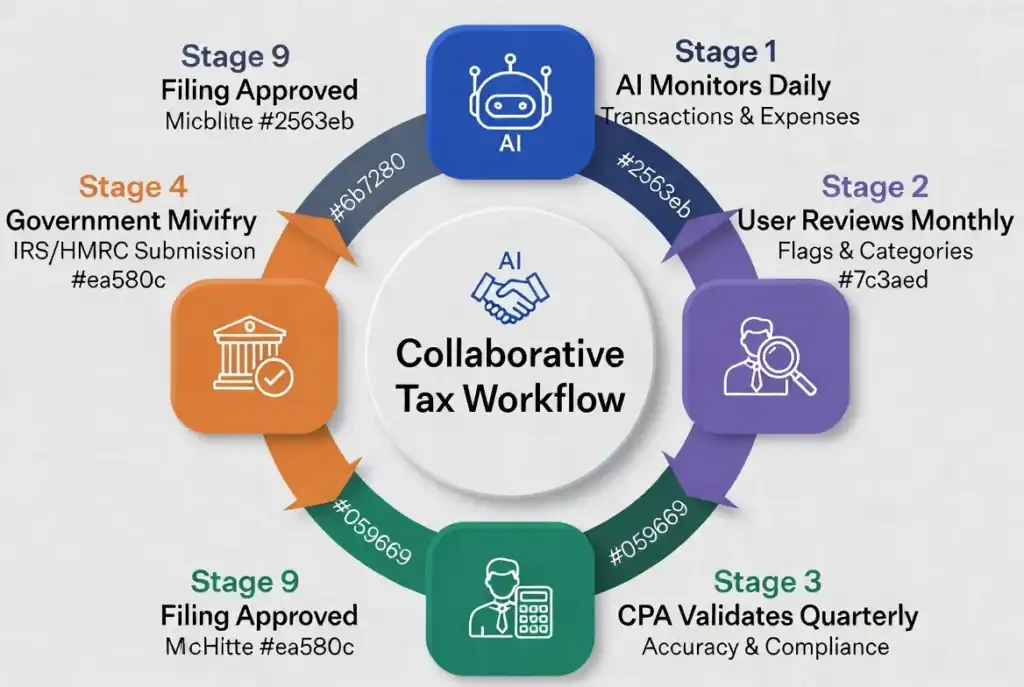
Best practice:
- AI monitors transactions daily
- AI flags potential deductions weekly
- You review flagged items monthly
- Your accountant reviews everything quarterly
- Your accountant signs and files annually
This isn’t “AI vs. humans”—it’s “AI + humans = better outcomes.”
Personal experience: I use an AI tool for expense tracking, but my CPA still reviews everything before filing. Last year, the AI caught legitimate deductions I’d missed. My CPA caught errors the AI made (incorrectly categorizing personal expenses). Both saved me money.
Key Takeaway: The human-in-the-loop model combines AI efficiency with professional judgment, creating the safest and most effective tax compliance workflow.
<a name=”pricing-and-cost-considerations”></a>
Pricing & Cost Considerations
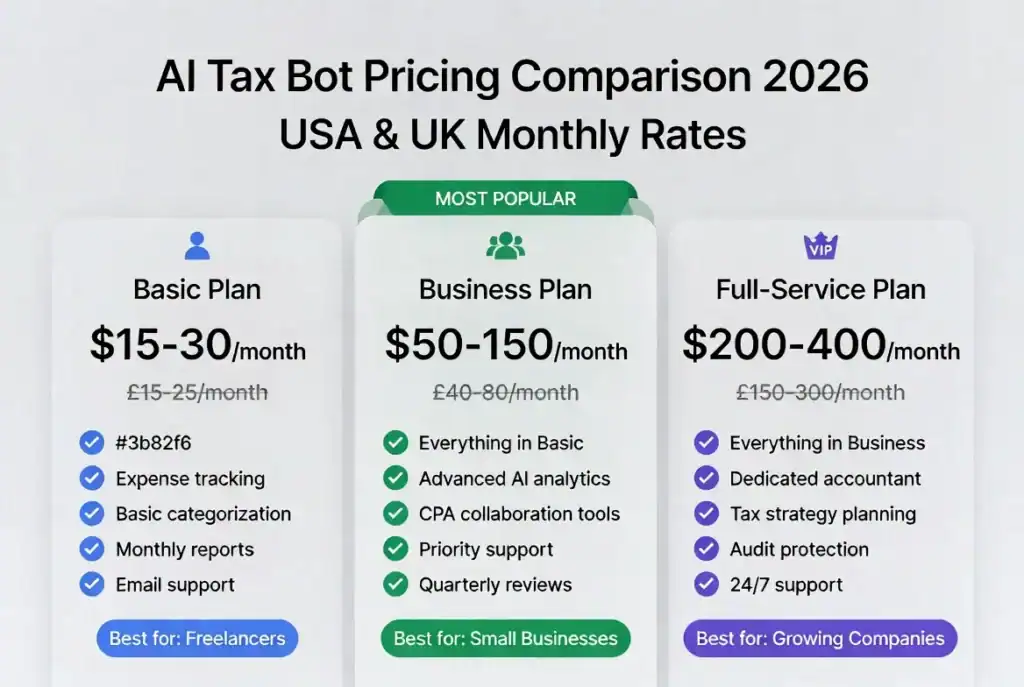
USA Pricing (USD)
- Basic freelancer tools: $15–$30/month
- Small business platforms: $50–$150/month
- Full-service AI + accountant: $200–$400/month
Budget advice: If you’re a solo freelancer making under $75k/year, stick with the lower-tier options. If you’re an LLC or S-Corp doing substantial revenue, invest in mid-tier platforms plus quarterly CPA reviews.
UK Pricing (GBP)
- Self Assessment tools: £15–£35/month
- Ltd company platforms: £40–£80/month
- Full-service AI + accountant: £150–£300/month
Budget advice: Sole traders can manage with affordable monthly tools. Ltd companies should budget for mid-range platforms, especially if VAT-registered.
Hidden Costs
- Accountant review fees: Budget $300–$600 (USA) or £200–£400 (UK) annually for professional oversight
- Learning curve time: Expect several hours to set up integrations properly
- Migration costs: If switching from manual systems, you’ll spend time backfilling data
Key Takeaway: Total cost of AI tax automation includes software subscription plus professional review fees—budget for both to ensure compliant, effective implementation.
<a name=”pros-and-cons”></a>
Pros & Cons
Pros
- Time savings: Compress hundreds of hours of annual tax work to manageable amounts
- Better compliance: AI doesn’t forget deadlines or miss receipt uploads
- Discovered deductions: Most users find more legitimate deductions with systematic tracking
- Reduced accountant fees: By doing prep work, you pay CPAs for strategy instead of data entry
- Real-time visibility: Know your tax position monthly, not just during filing season
Cons
- Cannot replace professional judgment: Complex scenarios still need human expertise
- Learning curve: Initial setup is tedious (linking accounts, categorizing transactions)
- Subscription fatigue: Yet another monthly software bill
- Over-reliance risk: Some users blindly trust AI without reviewing output
- Audit limitations: AI cannot represent you if HMRC or IRS comes knocking
What I’ve observed: The biggest mistake is treating AI tax tools as “set and forget.” You still need to review regularly. I’ve watched people let AI run unsupervised for months, then discover it miscategorized significant expenses. Regular brief reviews prevent this.
Key Takeaway: AI tax automation delivers substantial time and accuracy benefits but requires ongoing user oversight and professional validation to avoid costly errors.
In the high-stakes arena of AI productivity, choosing the right model isn’t just a technical decision—it’s a foundational business strategy. For entrepreneurs focused squarely on the bottom line, our Grok vs ChatGPT 5: Entrepreneur ROI Analysis 2026 provides a ruthless, numbers-driven breakdown of which platform delivers real value for your investment.
But what if your needs lean more toward raw, versatile intelligence and exceptional coding prowess? That’s where the quiet contender enters the ring. In our head-to-head comparison, DeepSeek AI vs ChatGPT 5, we pit this formidable open-source challenger against the established giant, revealing a powerful and cost-effective alternative that could be the secret weapon for your next big venture. Dive into both analyses to arm yourself with the insights needed to build, scale, and outmaneuver the competition.
<a name=”faqs”></a>
FAQs
Are agentic tax bots legal in the USA and UK?
Yes. Agentic tax bots are legal in both the USA and the UK when used as compliance-assist tools. They may automate data classification, record reconciliation, and deduction identification, provided final filings are reviewed and approved by a qualified human professional.
Can AI tax bots replace accountants or tax advisors?
No. AI tax bots cannot replace licensed accountants or tax advisors. They support professionals by reducing manual work, but do not provide legal tax advice or submit filings independently.
What tasks can agentic tax bots automate safely?
Agentic tax bots can safely automate expense categorization, document ingestion, transaction reconciliation, audit trail preparation, and draft compliance reports, while leaving final decisions to human reviewers.
Are AI tax bots accepted by the IRS and HMRC?
The IRS and HMRC accept filings prepared with AI assistance as long as submissions meet existing compliance requirements and are reviewed by a responsible taxpayer or licensed professional.
Who should not use an AI tax bot?
Individuals with complex cross-border tax exposure, unresolved audits, or highly irregular income structures should not rely on AI tax bots without direct professional supervision.
Related AI Accounting Guides
- Best AI Accounting Software for Small Businesses in 2026
https://aigoldrushhub.com/best-ai-accounting-software-small-businesses-2026/ - AI Bookkeeping Tools for Small Businesses
https://aigoldrushhub.com/ai-bookkeeping-accounting-tools-small-business/ - The AI Tax Shield Strategy for 2026
https://aigoldrushhub.com/the-ai-tax-shield-2026/ - AI in Fintech: Tools, Trends, and Opportunities
https://aigoldrushhub.com/ai-in-fintech-2026-tools-trends-opportunities/
<a name=”final-insights”></a>
Final Insights
Here’s what appears likely for 2026:
Observation 1: A growing percentage of US Schedule C filers and UK Self Assessment filers will likely use some form of AI-assisted tax tool. This represents efficiency adoption, not hype.
Observation 2: The IRS and HMRC may release stricter audit trail requirements for AI-generated filings. Early adopters who maintain clean documentation will benefit; sloppy users will face challenges.
Observation 3: Accountants who resist AI integration may lose clients to those who embrace collaborative workflows. The future appears to be “AI-powered accountants vs. manual accountants.”
Final advice: Don’t adopt AI tax tools to circumvent the system. Adopt them to stay compliant more efficiently. The goal isn’t paying zero tax (that’s illegal). The goal isto payg exactly what you owe—not a dollar more, not a dollar less.
If you’re a US freelancer missing deductions or a UK sole trader managing MTD requirements, test one platform this quarter. Run it for 90 days. Have your accountant review the output. If it saves you meaningful time and finds legitimate missed relief, continue.
And remember: the best tax strategy is still earning more money. AI helps you spend less time on compliance so you can focus on that.
Bookmark this guide and revisit it every six months—tax tech moves fast, and what’s cutting-edge today will be standard by 2027.
Summary: 5 Key Takeaways
- Agentic tax bots automate transaction monitoring and deduction flagging, but they require human professional review—they’re prep tools, not replacements for CPAs or chartered accountants.
- Both the IRS and HMRC permit AI-assisted tax planning under strict conditions: audit trails must be maintained, professionals must sign filings, and you remain personally liable for accuracy.
- Most users discover more legitimate deductions when switching to AI-assisted workflows—not because of shortcuts, but because AI doesn’t forget to track expenses as humans do.
- USA and UK use cases differ significantly: US tools focus on Schedule C, 1099 income, and estimated taxes; UK tools prioritize MTD compliance, VAT, and Corporation Tax optimization.
- The biggest risk is over-reliance—treating AI as infallible leads to audit exposure. Regular reviews and professional oversight are non-negotiable for safe, compliant use.
Disclaimer
This article is for educational purposes only and does not constitute financial, legal, or tax advice. Tax laws vary by jurisdiction and individual circumstances. Always consult a qualified CPA (USA), chartered accountant (UK), or registered tax professional before making tax decisions. The author and AI Goldrush Hub assume no liability for actions taken based on this content.
About the Author
Zain is the founder of AI Goldrush Hub, where he breaks down AI-driven finance.
into actionable strategies for building wealth. With a background in fintech, Zain focuses on analyzing publicly available guidance, real-world tool behavior, and professional workflows rather than offering tax advice. He helps US and UK audiences navigate the intersection of artificial intelligence and money—without the hype, just the data.
Check for updates annually—rules, rates, and tools may change.
SEO Tags
agentic tax bots, AI tax planning 2026, IRS compliant AI tools, HMRC tax automation, AI tax software USA, AI tax software UK, Schedule C AI tools, Self Assessment automation, Making Tax Digital AI, tax compliance bots, AI accounting tools, small business tax automation, freelancer tax planning, agentic AI finance, tax bot comparison 2026











Show Comments[…] The AI Tax Shield Strategy for 2026https://aigoldrushhub.com/the-ai-tax-shield-2026/ […]
[…] The AI Tax Shield Strategyhttps://aigoldrushhub.com/the-ai-tax-shield-2026/ […]
[…] The AI Tax Shield Strategyhttps://aigoldrushhub.com/the-ai-tax-shield-2026/ […]
[…] The AI Tax Shield Strategyhttps://aigoldrushhub.com/the-ai-tax-shield-2026/ […]
[…] The AI Tax Shield Strategy for 2026https://aigoldrushhub.com/the-ai-tax-shield-2026/ […]
[…] The AI Tax Shield Strategy for 2026https://aigoldrushhub.com/the-ai-tax-shield-2026/ […]