

Quick Answer: AI bookkeeping and accounting tools automate transaction categorization, bank reconciliation, invoice processing, and financial reporting — saving small businesses 10–20+ hours per month. The best platforms in 2026 combine machine learning accuracy with human oversight, integrating directly with QuickBooks or Xero. Costs range from $0 (Wave) to $500+/month for full-service hybrid solutions.
Introduction
Running a small business means wearing too many hats. Bookkeeping — while essential — is rarely the reason anyone started a company. Yet errors in your books can cost you thousands in missed deductions, tax penalties, or poor cash flow decisions.
AI bookkeeping and accounting tools are changing that equation in 2026. They automate the repetitive work — categorizing expenses, reconciling accounts, chasing invoices — so you can focus on growth. In fact, over 80% of small and medium-sized businesses now use cloud accounting systems, making AI-powered automation the new default rather than a premium add-on.
This guide covers the top AI finance software options for small businesses, how they compare on pricing and features, the real implementation challenges most reviews skip, and what actually works based on hands-on experience.
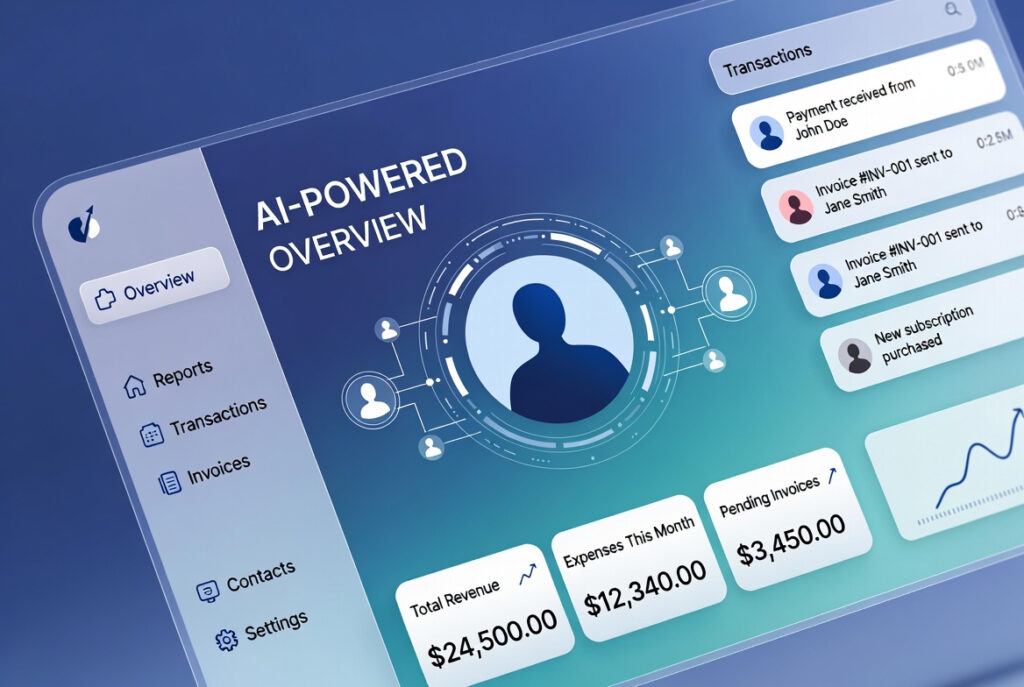
What Are AI Bookkeeping & Accounting Tools?
AI bookkeeping tools use machine learning (ML), natural language processing (NLP), and optical character recognition (OCR) to automate financial workflows that once required manual data entry.
Instead of logging into your bank account, downloading a CSV, and manually tagging each transaction, an AI accounting platform connects directly to your financial institutions. It learns your spending patterns, applies intelligent categorization rules, flags anomalies, and generates financial reports — in real time, not at month-end.
The key distinction worth understanding:
- Bookkeeping AI handles day-to-day transaction recording, categorization, and reconciliation.
- Accounting AI goes further — analyzing data, generating forecasts, managing tax compliance, and providing strategic financial insights.
Most modern platforms now blend both. In 2026, the most significant shift is the rise of agentic AI — autonomous agents that don’t just suggest an action, they execute it. Platforms like QuickBooks (Intuit Assist) and Xero (Ask Xero / JAX) now embed these agents directly into everyday workflows.
H3: What tasks can AI automate in accounting?
AI can automate a broad range of accounting tasks, including: transaction categorization, bank and credit card reconciliation, invoice generation and tracking, receipt scanning via OCR, accounts payable routing, payroll processing, tax estimate calculations, cash flow forecasting, anomaly and fraud detection, and month-end close reporting. In 2026, AI-powered tools can handle 80–90% of routine bookkeeping tasks automatically, with human oversight reserved for complex judgment calls.
More AI Finance & Accounting Resources
- Best AI Accounting Tools for Small Businesses
https://aigoldrushhub.com/best-ai-accounting-tools-small-business/ - Best AI Accounting Software for Small Businesses
https://aigoldrushhub.com/best-ai-accounting-software-small-businesses-2026/ - The AI Tax Shield Strategy
https://aigoldrushhub.com/the-ai-tax-shield-2026/ - OBBB Act Tax Savings AI Guide
https://aigoldrushhub.com/obbb-act-tax-savings-ai-guide-2026/
The Business Case: Why Automate Accounting in 2026?
The numbers tell a compelling and accelerating story.
Table 1: AI in Accounting — Key Market Statistics (2026)
| Metric | Data Point | Source |
|---|---|---|
| Global AI in accounting market size (2026) | $10.87 billion | Mordor Intelligence (updated Jan 2026) |
| Projected market size by 2031 | $68.75 billion | Mordor Intelligence |
| CAGR (2026–2031) | 44.6% | Mordor Intelligence |
| SME AI accounting CAGR (2026–2031) | 45.2% | Mordor Intelligence |
| Cloud-based accounting — SMB adoption rate | 80%+ of small businesses | ERP Peers / Industry Research (2026) |
| Cloud accounting share of new deployments | 61.72%+ and rising | Mordor Intelligence |
| Accounting tasks viewed as automatable | ~50% with current AI | Online Accounting Software Market Report (2026) |
| AI bookkeeping — routine task automation rate | 80–90% | Run Eleven / Industry benchmarks (2026) |
| Tax AI handling routine tasks by 2026 | ~90% of routine tasks | EY projection |
| Audit procedures expected to be automated by 2026 | 50%+ | Industry consensus |
Source: Mordor Intelligence AI in Accounting Market Report (updated January 2026); ERP Peers Top Accounting Software for Small Business (2026); Run Eleven AI Bookkeeping Guide (2026); EY and KPMG published outlook reports. Data accurate as of [PUBLICATION DATE]. Verify the current figures directly against the cited sources.
The global AI in accounting market is estimated at $10.87 billion in 2026, growing from $7.52 billion in 2025, with projections reaching $68.75 billion by 2031 at a 44.6% CAGR. This explosive trajectory is powered by generative AI breakthroughs, mandatory digitization for invoicing and tax submissions, and enterprise-wide cloud migrations that collectively automate labor-intensive financial workflows.
In 2026, over 80% of small and medium-sized businesses use cloud accounting systems, making it the default standard rather than a premium choice.
H3: How much time can AI bookkeeping tools save a small business?
For a small business processing 100–300 transactions per month, AI bookkeeping tools typically save 10–20+ hours of manual work monthly. Time savings concentrate in bank reconciliation (often 60–80% faster), invoice processing (near-instant with OCR), and month-end close (reduced from days to hours). AI accounting tools automate everything from data entry to expense organization to account reconciliation, with machine learning identifying spending trends and classifying expenses in the proper categories automatically. Exact savings vary based on transaction volume, tool configuration, and initial data quality.
How AI Bookkeeping Works in 2026: A New Operating Model
The workflow of AI bookkeeping has changed significantly. In 2026, the workflow is continuous rather than periodic — modern AI systems integrate directly with your financial ecosystem, pulling data via APIs from bank feeds, credit cards, payroll providers, and point-of-sale systems in real time.
Once data is ingested, NLP and ML take the wheel — if the system sees a charge from a vendor, it analyzes the context, cross-references the entry against tax rules, and determines deductibility automatically. Traditional bookkeeping thatwaitsd until the month-end to reconcile is giving way to AI systems that perform reconciliation in real time.
There is also a major transparency shift underway. Today’s AI is increasingly explainable — if a system categorizes an expense, it can show the logic behind that choice, which is crucial for regulatory compliance and gives business owners confidence during tax season.
Top AI Bookkeeping & Accounting Tools Compared (2026)
Here is how the leading platforms stack up across the features that matter most to small businesses this year.
Table 2: AI Bookkeeping & Accounting Tools — Platform Comparison (2026)
| Platform | Best For | Key AI Features | Starting Price (2026) | Integrations | Human Oversight |
|---|---|---|---|---|---|
| QuickBooks Online + Intuit Assist | Established small businesses | Agentic AI categorization, Payments Agent, Finance Agent, Payroll Agent, anomaly detection | ~$30/month (Simple Start) | 750+ apps | Via QuickBooks Live add-on |
| Xero + JAX (Just Ask Xero) | Growing businesses, multi-currency | Conversational AI assistant, real-time ML categorization, 21,000+ bank connections | ~$15/month (Early) | 1,000+ apps | Third-party accountants |
| Booke AI | Bookkeepers using QBO/Xero | 98% accuracy categorization, automated reconciliation, document matching, OCR | Custom pricing | QuickBooks, Xero | Optional human review |
| Puzzle | Startups and high-growth companies | AI-native architecture, 98% auto-categorization, real-time burn/runway tracking | Custom | Stripe, Mercury, Ramp, Brex, Gusto | Built-in oversight |
| Digits | General SMBs replacing accountants | Agentic bookkeeping, autonomous transaction processing, full-service model | Custom (request demo) | 12,000+ financial institutions | Optional; AI-first model |
| Botkeeper | Accounting firms serving SMBs | Hybrid AI + human model, bank recon, transaction coding, journal entries | Custom (per client) | QuickBooks, Xero, others | Human accountant review |
| Docyt AI | Multi-location businesses | Full-stack bookkeeping automation, real-time P&L, bill pay, expense management | Custom | QuickBooks and major ERPs | Built-in review workflows |
| Wave | Sole proprietors, freelancers | Automated bank feeds, receipt scanning, basic AI categorization | Free (payments/payroll extra) | Limited | Manual or paid advisor |
| Zeni | Funded startups | Real-time AI bookkeeping, AI invoice processing, expense automation | Custom (full-service) | Major banks, payroll tools | Dedicated finance team |
| Truewind | Startups seeking CFO support | AI bookkeeping + financial modeling + fractional CFO | Custom ($500K–$3M revenue range) | QuickBooks, Sage Intacct | Dedicated human accountant |
Note: Pricing changes frequently. QuickBooks Online pricing in 2026 starts at $30/month for Simple Start, $60 for Essentials, $90 for Plus, and $200 for Advanced. Xero pricing starts at $15/month for the Early plan, $42 for Growing, and $78 for Established. Always verify current rates directly with vendors, as promotional discounts are common.
How to Choose the Right AI Accounting Tool: A Step-by-Step Framework
Choosing the wrong platform is expensive — both in subscription cost and the time spent migrating data later. Follow this process before committing.
Step 1: Audit your current bookkeeping workflow. List every task that currently takes more than 30 minutes per week — bank reconciliation, receipt collection, invoice follow-up, and report generation. These are your automation targets.
Step 2: Assess your transaction volume. Platforms price and perform very differently at 50 transactions/month versus 500. Know your baseline before requesting demos.
Step 3: Identify your existing software stack. QuickBooks suits US-focused, compliance-heavy businesses, whereas Xero fits global companies seeking flexibility, automation, and scalable accounting. If you already use one, choose a tool that layers on top of or deeply integrates with your existing general ledger.
Step 4: Decide how much human oversight you need. Pure AI tools are cheaper but require you to review outputs regularly. Hybrid platforms (Botkeeper, Zeni, Truewind) pair automation with human accountants — essential for businesses with complex revenue streams, multiple entities, or investor reporting requirements.
Step 5: Request a trial with real data. Most vendors offer demos or trial periods. Import three months of real transactions and evaluate categorization accuracy before signing an annual contract.
Step 6: Calculate total cost of ownership. A monthly subscription is only one component. Factor in setup fees, integration costs, overage charges (some platforms charge per transaction above a threshold), and the cost of any human review tier you may need.
Cost Breakdown: What AI Accounting Tools Actually Cost in 2026
Headline pricing rarely tells the full story.
Table 3: AI Accounting Tool Cost Comparison — Small Business Scenarios (2026)
| Cost Category | DIY AI Tools (e.g., Wave + Booke AI) | Mid-Tier AI Platform (e.g., QuickBooks Plus) | Full-Service Hybrid (e.g., Zeni, Truewind) |
|---|---|---|---|
| Monthly subscription | $0–$50 | $90–$200 | $300–$1,500+ |
| Setup / onboarding fee | $0–$500 | $0–$300 | Often included |
| Per-transaction overages | Varies | Rare | Rare (volume-based) |
| Add-on integrations | $0–$50/month | Included or $5–$30/app | Usually included |
| Human CPA access | $0 (not included) | $50–$500/month (QuickBooks Live) | Included |
| Estimated annual cost | $0–$1,200 | $1,080–$4,200 | $3,600–$18,000+ |
Illustrative ranges for educational purposes. Actual costs vary significantly by vendor, transaction volume, number of entities, and plan tier. Always request itemized quotes. Verify all pricing directly with vendors. When switching platforms, budget $500–$2,000 in CPA time for data migration, historical record setup, and verification, depending on complexity.
Hidden costs to watch for in 2026:
- Payroll processing fees (often separate from accounting subscriptions)
- Per-seat user licensing beyond plan limits
- Historical data migration (some vendors charge for importing prior-year data)
- Training and onboarding time (internal staff hours are real costs)
- Costs of correcting AI categorization errors if review workflows are not established
- Integration middleware costs (Zapier, Make) for connecting AI tools to e-commerce or payroll platforms
- More AI Finance & Accounting Resources
- Best AI Accounting Tools for Small Businesses
https://aigoldrushhub.com/best-ai-accounting-tools-small-business/ - Best AI Accounting Software for Small Businesses
https://aigoldrushhub.com/best-ai-accounting-software-small-businesses-2026/ - The AI Tax Shield Strategy
https://aigoldrushhub.com/the-ai-tax-shield-2026/ - OBBB Act Tax Savings AI Guide
https://aigoldrushhub.com/obbb-act-tax-savings-ai-guide-2026/
AI Accounting Tool Evaluation Scoring Matrix
Table 4: Platform Evaluation — Scoring Matrix for Small Business Use Cases (2026)
| Platform | Ease of Use (1–5) | AI/NLP Quality (1–5) | Integration Depth (1–5) | Human Support Access (1–5) | Cost Efficiency (1–5) | Overall Score |
|---|---|---|---|---|---|---|
| QuickBooks Online + Intuit Assist | 5 | 4 | 5 | 4 | 3 | 21/25 |
| Booke AI | 4 | 5 | 4 | 3 | 4 | 20/25 |
| Wave | 5 | 3 | 3 | 2 | 5 | 18/25 |
| Xero + JAX | 4 | 4 | 5 | 3 | 4 | 20/25 |
| Puzzle | 3 | 5 | 4 | 4 | 3 | 19/25 |
| Botkeeper | 3 | 4 | 4 | 5 | 3 | 19/25 |
| Docyt AI | 3 | 4 | 4 | 4 | 3 | 18/25 |
| Truewind | 3 | 5 | 4 | 5 | 2 | 19/25 |
| Zeni | 3 | 5 | 4 | 5 | 2 | 19/25 |
Scores are based on publicly available feature comparisons, user reviews, and documented capabilities as of early 2026. Scoring is subjective and should be validated against your specific use case.
The Reality Check: Why Some AI Accounting Automations Fail in 2026
Most reviews of AI accounting software present a clean, frictionless picture. The reality is more nuanced.
After working with dozens of small businesses implementing accounting automation, a consistent pattern of failure points emerges. Understanding these in advance is what separates a successful implementation from an expensive rollout that gets abandoned six months in.
1. Garbage data in, garbage data out. AI categorization learns from historical transactions. If your chart of accounts is poorly structured, or if prior years contain miscategorized entries, the AI will replicate those errors — at scale and at speed. Before migrating to an AI platform, clean your existing books. Data migration issues are cited by 34% of businesses as a key challenge in accounting software adoption.
2. Over-reliance on automation without a review workflow. Setting up AI-powered bank feeds and then never reviewing them is the single most common mistake. AI categorization accuracy of 95–98% sounds impressive until you realize that on 500 monthly transactions, that is 10–25 misclassified entries per month. Without a scheduled review cadence, errors compound into year-end chaos.
3. Integration complexity is underestimated. Integration with business systems like ERP and payroll is demanded by 70% of enterprise buyers in 2026. Connecting an AI bookkeeping layer to existing payroll tools, e-commerce platforms (Shopify, Amazon), and payment processors (Stripe, Square) often requires technical configuration or third-party middleware. Vendors demonstrate the best-case scenario in demos; real integrations take time.
4. AI cannot replace professional judgment on complex transactions. Intercompany transfers, revenue recognition for SaaS subscriptions, deferred revenue, inventory costing methods, and R&D capitalization require human accounting expertise. AI tools flag them; they rarely resolve them correctly without human input.
5. Plan tier traps. Several major platforms gate their most useful AI features behind premium tiers. A small business may sign up for an entry-level plan and discover that the automation they actually need — reconciliation agents, cash flow forecasting, multi-user access — requires a plan costing two to three times more.
6. Vendor lock-in risk. Migrating financial data between platforms is painful and costly. Switching platforms results in a 2–3 month period of reduced efficiency while learning the new system, and migrated data is rarely as clean as native data, causing report comparability issues. Before committing to any ecosystem, verify data export capabilities in standard formats (CSV, QBO, OFX).
H3: Can AI replace a human accountant or bookkeeper in 2026?
No, not in full, and not for most small businesses. AI doesn’t replace bookkeepers — it enhances their capabilities, shifting them from data entry to roles that emphasize financial oversight, compliance, and strategic insight. Strategic tax planning, complex revenue recognition, financial statement audits, and advisory conversations still require human expertise. The most effective model pairs AI automation with periodic human review.
Verified Case Studies
Case Study 1: Botkeeper — Accounting Firm Scaling Client Services
Background: A small US-based accounting firm serving 40+ small business clients. Each client used different banking platforms, creating a reconciliation bottleneck that limited the firm’s capacity to grow.
Problem: Manual bank reconciliation across all clients consumed disproportionate staff hours. The firm could not take on additional clients without hiring more staff — eroding margins.
Solution: The firm implemented Botkeeper’s hybrid AI + human bookkeeping platform. The system automated bank reconciliation and transaction categorization for standard transaction types (roughly 80% of all entries), while flagging unusual items for human review.
Reported Outcome: According to Botkeeper’s published documentation, firms using their hybrid model have achieved up to 10x faster reconciliation for clients in the 50–200 monthly transaction range. The firm increased client capacity without proportional headcount additions.
Source: Botkeeper platform documentation and case study materials at botkeeper.com. (Verify current metrics directly with Botkeeper, as published figures are subject to update.)
Case Study 2: Puzzle — Startup AI-Native Accounting (Verified Platform Reference)
Background: Puzzle is an AI-native accounting platform built specifically for US-based startups and the accounting firms that serve them, launched as a direct response to the limitations of legacy platforms for high-growth companies.
Problem: High-growth startups found that traditional accounting platforms required manual processes to track burn rate, runway, and cash position — metrics that modern investors expect in real time, not at month-end.
Solution: Puzzle built an AI-native architecture from the ground up, with up to 98% automated transaction categorization using AI that learns specific business patterns, native tracking for cash position, burn rate, runway, and ARR/MRR updated daily, and fintech integrations with Stripe, Mercury, Ramp, Brex, and Gusto that connect in minutes.
Outcome: Startups using Puzzle gain real-time financial visibility without waiting for month-end close — a structural advantage for boards and investors requiring current data.
Source: Puzzle.io platform documentation at puzzle.io. (Readers should verify current feature availability and pricing directly with Puzzle, as the platform continues to evolve rapidly.)

Measuring ROI: Metrics That Matter
Do not adopt an AI accounting tool without establishing baseline metrics to track. ROI in accounting automation is real — but it must be measured deliberately.
Table 5: ROI Tracking Metrics for AI Accounting Automation (2026)
| Metric | What to Measure | Target Benchmark |
|---|---|---|
| Time to close month-end books | Hours from period end to finalized reports | 50–75% reduction vs. manual baseline |
| Transaction categorization accuracy | % of transactions correctly auto-categorized | 95–98% (review remainder manually) |
| Invoice-to-payment cycle time | Days from invoice sent to payment received | 20–30% reduction with automated follow-up |
| AP processing time per invoice | Minutes per invoice from receipt to approval | Target <2 minutes with AI OCR |
| Reconciliation errors per period | # of discrepancies requiring manual correction | Trending toward zero over 90 days |
| Cost per accounting hour | Total accounting costs ÷ hours of work output | Track quarterly; target 20–40% reduction |
| Compliance deadlines met | % of tax/filing deadlines met on time | 100% (AI reminders and automated prep) |
Benchmarks are illustrative estimates for educational purposes. Actual results vary significantly based on business complexity, transaction volume, platform quality, and implementation discipline.
From My Experience — Zain’s Perspective
I have spent the better part of three years researching and advising businesses on accounting automation — from solo freelancers adopting Wave for the first time to funded startups evaluating full-service platforms like Zeni, Truewind, and Puzzle.
Here is what I have learned that most review articles do not tell you in 2026.
What worked:
- Starting with one workflow, not everything at once. The businesses that saw the fastest returns focused their first 90 days on automating bank reconciliation alone. Master that, then layer in invoice automation, then expense tracking. Trying to automate everything simultaneously creates confusion and erodes trust in the system.
- Treating the AI as a junior bookkeeper, not an autonomous system. The mental model shift that worked best: imagine AI as a capable but new employee who needs spot-checks. Weekly 30-minute reviews of AI-categorized transactions caught edge cases before they became year-end problems.
- Choosing AI-native over retrofitted AI. In 2026, there is a meaningful gap between platforms built from day one with AI at the core (like Puzzle for startups) versus legacy platforms that bolted AI features onto older architecture. The difference shows up in real-time data accuracy, integration reliability, and how the system handles complex transaction types.
- Hybrid platforms for businesses with complexity. Any business with multiple revenue streams, contractor payroll, or inventory should invest in a platform that includes human accountant oversight. The cost difference between a DIY AI tool and a hybrid service is minor compared to the cost of a tax filing error.
What did not work:
- Migrating to a new AI platform with uncleaned historical data. I watched one e-commerce client spend three months cleaning up miscategorized transactions after importing five years of messy QuickBooks data into an AI platform. Data hygiene before migration is non-negotiable.
- Assuming integrations work out of the box. Stripe → AI accounting platform → payroll tool sounds simple. In practice, payment splits, refunds, and subscription revenue recognition created edge cases that the AI consistently mishandled until custom rules were configured. Budget time for integration troubleshooting.
- Choosing the cheapest entry-level plan without checking feature gates. Two clients signed up for entry-level plans on major platforms only to discover the AI reconciliation and reporting features they actually needed required plans costing significantly more. Always map your required features to specific plan tiers before committing.
- Assuming 98% accuracy is good enough without a review workflow. At high transaction volumes, even a 2% error rate compounds quickly. One manufacturing client with 800 monthly transactions had 16 miscategorized entries per month — manageable with a weekly review, catastrophic if left unchecked for a quarter.
Key takeaways for 2026:
- AI accounting tools deliver real time savings — but only if you invest time upfront in clean data, proper setup, and a review workflow.
- The gap between AI-native platforms and retrofitted AI tools is widening. In 2026, this distinction matters more than ever when evaluating tools for high-growth businesses.
- Human accountant access is not optional for businesses making high-stakes financial decisions. It is a cost of responsible financial management.
- Revisit your tool selection annually. The AI accounting software landscape is evolving faster than almost any other business software category.

Market Trends: Where AI Accounting Is Heading Beyond 2026
Table 6: AI Accounting Market Outlook — Key Trends and Data Points (2026 and Beyond)
| Trend | Current Data (2026) | Projected Direction |
|---|---|---|
| Market growth trajectory | $10.87 billion in 2026 → $68.75 billion by 2031 (Mordor Intelligence) | 44.6% CAGR sustained |
| Agentic AI deployment | Embedded in QuickBooks (Intuit Assist) and Xero (JAX) in active rollout | Mainstream across all major platforms within 1–2 years |
| Cloud accounting adoption | 80%+ of SMBs using cloud accounting (2026) | Near-universal by 2027–2028 |
| Automated bookkeeping growth | Fastest-growing AI accounting segment at 46.1% CAGR (Mordor Intelligence, 2026–2031) | Will dominate new deployments |
| SME AI adoption pace | 45.2% CAGR in SME segment (2026–2031) | Outpacing large enterprise adoption |
| Real-time financial close | Moving from monthly to continuous close for SMBs | Enabled by always-on AI reconciliation agents |
| Tax AI automation | ~90% of routine tax tasks automated by 2026 (EY projection) | Full compliance AI integration by 2027 |
| Asia-Pacific growth | 46.2% CAGR, fastest regional growth in AI accounting | Emerging as second-largest market by 2028 |
Source: Mordor Intelligence AI in Accounting Market Report (updated January 2026); ERP Peers (2026); EY and KPMG published outlook reports. Projections are forward-looking and subject to change.
FAQ: AI Bookkeeping & Accounting Tools (2026)
What is the best AI accounting tool for a small business just starting out in 2026?
For businesses with simple financials and tight budgets, Wave remains the strongest free option with basic AI-assisted accounting for sole proprietors and early-stage companies. For businesses wanting deeper automation, QuickBooks Online (Simple Start at ~$30/month) offers a strong balance of AI capability and ecosystem integrations. Xero’s Early plan (~$15/month) is a strong alternative for businesses preferring a modern interface with unlimited users on all plans.
How much does it cost to automate small business accounting with AI in 2026?
Costs range widely. Free tools like Wave cover basic bookkeeping at no subscription cost. Mid-tier AI platforms like QuickBooks Online range from approximately $30–$200/month depending on plan. Full-service hybrid platforms (with human accountant access) typically start around $300–$500/month. Always request itemized pricing and verify overage policies directly with vendors, as pricing changed significantly from 2025 to 2026.
Can AI bookkeeping tools handle taxes for my small business?
AI tools automate tax-related tasks such as expense categorization, sales tax tracking, estimated tax calculations, and generating the financial reports your accountant needs. EY projects that approximately 90% of routine tax tasks are now automatable with AI in 2026. However, filing business tax returns, strategic tax planning, and handling IRS correspondence still require a licensed CPA or tax professional.
What is the difference between AI-native and AI-retrofitted accounting platforms?
AI-native platforms (like Puzzle) are built from the ground up with machine learning at their core — every feature, integration, and workflow is designed around AI processing. AI-retrofitted platforms (like QuickBooks and Xero in their earlier versions) added AI layers onto existing legacy architecture. In 2026, AI-native tools generally deliver higher accuracy, real-time data visibility, and better handling of complex transactions, but may lack the broad ecosystem of established platforms.
How accurate is AI transaction categorization in 2026?
Leading platforms now report categorization accuracy of 95–98% for trained models on established business accounts. Accuracy is lower for new accounts with no transaction history or complex multi-category transactions. Always establish a weekly review process. At 98% accuracy on 500 monthly transactions, you still have 10 misclassified entries per month — manageable with oversight, problematic if left unchecked.
Is my financial data safe with AI accounting platforms in 2026?
Reputable platforms use bank-level encryption, SOC 2 Type II compliance, multi-factor authentication, and strict data governance policies. Cybersecurity concerns are cited by 39% of businesses as a key challenge in accounting software adoption. Before selecting any platform, review its security certifications, data retention policies, and breach notification procedures. For businesses in regulated industries, verify compliance with applicable data protection laws (GDPR, CCPA, etc.).
What happens when an AI accounting tool makes an error?
Errors happen — the key is catching them before they compound. Establish a weekly review cadence where a responsible team member or accountant reviews AI-categorized transactions. Most platforms provide exception flags and anomaly alerts. Frequent errors typically indicate a configuration problem (poorly structured chart of accounts, missing categorization rules) rather than a platform failure. Improve the training data, not just the manual corrections.
Do I still need an accountant if I use AI bookkeeping software in 2026?
Yes — for most small businesses. AI tools automate the data processing layer of accounting. They do not replace the professional judgment required for strategic tax planning, financial statement interpretation, business structure advice, or complex compliance issues. The ideal model is AI for execution and a CPA or fractional CFO for strategy. Many hybrid platforms (Zeni, Truewind, Botkeeper) bundle both into a single engagement, making this the most practical option for growing businesses.
Internal Link Placeholders
More AI Finance & Accounting Resources
- Best AI Accounting Tools for Small Businesses
https://aigoldrushhub.com/best-ai-accounting-tools-small-business/ - Best AI Accounting Software for Small Businesses
https://aigoldrushhub.com/best-ai-accounting-software-small-businesses-2026/ - The AI Tax Shield Strategy
https://aigoldrushhub.com/the-ai-tax-shield-2026/ - OBBB Act Tax Savings AI Guide
https://aigoldrushhub.com/obbb-act-tax-savings-ai-guide-2026/
External Source Links Referenced
- Mordor Intelligence — AI in Accounting Market Report (updated January 2026): https://www.mordorintelligence.com/industry-reports/artificial-intelligence-in-accounting-market
- ERP Peers — Top Accounting Software for Small Business (2026): https://erppeers.com/accounting-software-for-small-businesses/
- Run Eleven — AI Bookkeeping Complete Guide (2026): https://www.runeleven.com/blog/ai-bookkeeping
- Puzzle.io — QuickBooks Alternatives for Startups (2026): https://puzzle.io/blog/quickbooks-alternatives-for-startups
- Webgility — Xero vs QuickBooks Comparison (2026): https://www.webgility.com/blog/xero-vs-quickbooks
- Accounts Junction — AI-Driven Bookkeeping Services (2026): https://www.accountsjunction.com/blog/ai-bookkeeping-a-complete-expansion
Disclaimer
Data Accuracy: Market statistics, pricing figures, and platform feature descriptions in this article are accurate as of [PUBLICATION DATE]. The AI accounting software landscape evolves rapidly — particularly in 2026, where agentic AI features and pricing structures are shifting quarterly. Vendor pricing, feature availability, and platform capabilities change frequently.
Pricing Verification: All pricing information presented is for illustrative reference only. Readers must verify current pricing, plan terms, and feature availability directly with each vendor before making purchasing decisions.
Not Financial or Legal Advice: This article is for educational and informational purposes only. It does not constitute financial, tax, legal, or accounting advice. Consult a licensed CPA, tax advisor, or financial professional before making decisions that affect your business finances.
Results Disclaimer: Time savings, ROI projections, and efficiency gains referenced in this article are illustrative estimates or figures published by third-party research firms and vendors. Actual results vary significantly based on business size, transaction complexity, implementation quality, team capacity, and ongoing review discipline. No specific financial outcome is guaranteed.
Affiliate Disclosure: This publication may contain affiliate relationships with software vendors. Editorial decisions are made independently of commercial relationships.











[…] AI Bookkeeping Tools for Small Businesseshttps://aigoldrushhub.com/ai-bookkeeping-accounting-tools-small-business/ […]
[…] AI Bookkeeping Tools for Small Businesseshttps://aigoldrushhub.com/ai-bookkeeping-accounting-tools-small-business/ […]
[…] AI Bookkeeping Tools for Small Businesseshttps://aigoldrushhub.com/ai-bookkeeping-accounting-tools-small-business/ […]
[…] AI Bookkeeping Tools for Small Businesseshttps://aigoldrushhub.com/ai-bookkeeping-accounting-tools-small-business/ […]