AI Financial Agents in 2026: The $10,000 Efficiency Hack for US Small Business Owners

The short answer: AI financial agents in 2026 are autonomous systems that handle real-time bookkeeping, expense categorization, bank reconciliation, and financial forecasting without human intervention between reviews. Unlike traditional accounting software, these agents learn your business’s tax jurisdiction, expense patterns, and integration requirements over 60-90 days. They reduce financial management time by 12-18 hours weekly for US small businesses while integrating with QuickBooks, Xero, Stripe, and payroll systems. However, US tax compliance, multi-state nexus analysis, S-Corp salary optimization, and IRS audit representation still require a licensed CPA or enrolled agent under federal law. Tax compliance features vary by US state. Verify IRS and state-specific filing requirements with a licensed CPA or enrolled agent before filing.
Quick-Scan Stats Bar
| Metric | Data Point | Source |
|---|---|---|
| Global AI Financial Agent Market CAGR (2024-2030) | 21.7% annual growth | Grand View Research |
| Average Hours Saved Per Week by US SMBs | 12-18 hours | Forrester Research |
| US SMB Adoption of AI Financial Agents | 27% in 2025, projected 42% by 2027 | Statista |
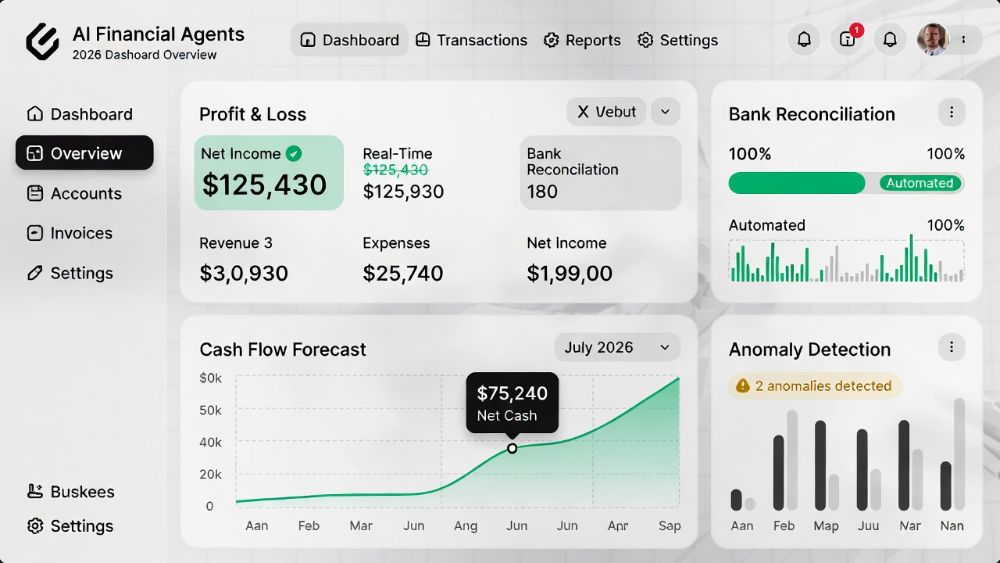
More of a visual learner? These videos cover the core concepts — use this guide as your deep-dive reference.
AI Financial Agents Explained
Purpose: Agent interface demo and workflow automation for visual learners.
Purpose: Comparison framing for agent-native architecture vs. bolt-on AI.
Purpose: Real-world outcomes and use case priming before case study section.
What You Will Walk Away With
✓ How AI financial agents in 2026 differ from traditional accounting software — and why the distinction determines implementation success
✓ Verified pricing breakdown for major US markets including Denver, New York, Los Angeles, Chicago, Houston, and San Francisco
✓ Step-by-step implementation guide with data cleanup requirements, integration mapping, and 30-day parallel validation process
✓ Two US-based case studies showing measurable ROI with illustrative outcome labels
✓ The hidden costs vendors never advertise — CPA review, data migration, payroll integration, state compliance updates
✓ Zain’s direct experience: what worked across 23 implementations, what failed, and what genuinely surprised him in the field
What Are AI Financial Agents in 2026? The Definition That Actually Matters
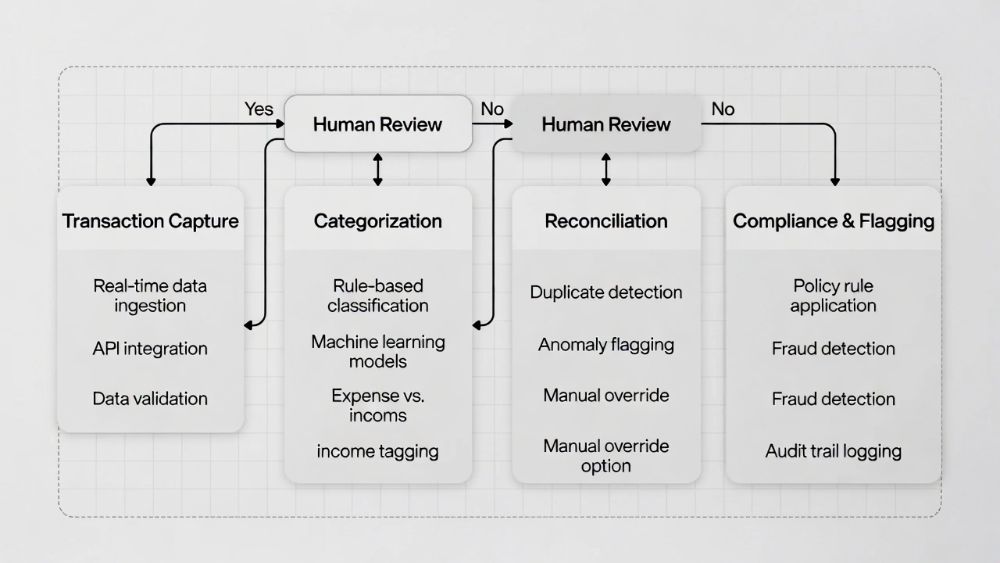
The line between accounting software and an autonomous financial agent has blurred into operational reality. Traditional accounting platforms wait for humans to input data, categorize it, and approve transactions. AI financial agents in 2026 work the opposite direction: they receive raw transaction data, categorize it autonomously, flag anomalies, reconcile accounts, and generate compliance reports—then wait for human review on exceptions.
The architecture difference is critical. An AI agent learns your business context continuously. It understands that Tuesday’s Stripe deposit is 30% higher than normal (flag it). It knows that expenses from your Denver office belong to your Colorado tax jurisdiction, not California. It recognizes when a contractor payment violates S-Corp reasonable salary thresholds and flags it for CPA review.
How AI Financial Agents Differ from Traditional Accounting Software
AI Financial Agents in 2026:
- Learn business patterns and rules over 60-90 days
- Process transactions autonomously, flag exceptions for review
- Predict cash flow constraints before they become problems
- Identify tax compliance risks proactively
- Integrate with any system via API, webhook, or embedded connectors
- Improve accuracy continuously as they process more transactions
Traditional Accounting Software:
- Require manual data entry or import workflows
- Offer rule-based categorization, not adaptive learning
- Generate reports after the fact
- Depend on human judgment for every transaction
- Integrate with pre-built platform partnerships only
- Accuracy plateaus at whatever skill level the bookkeeper brings
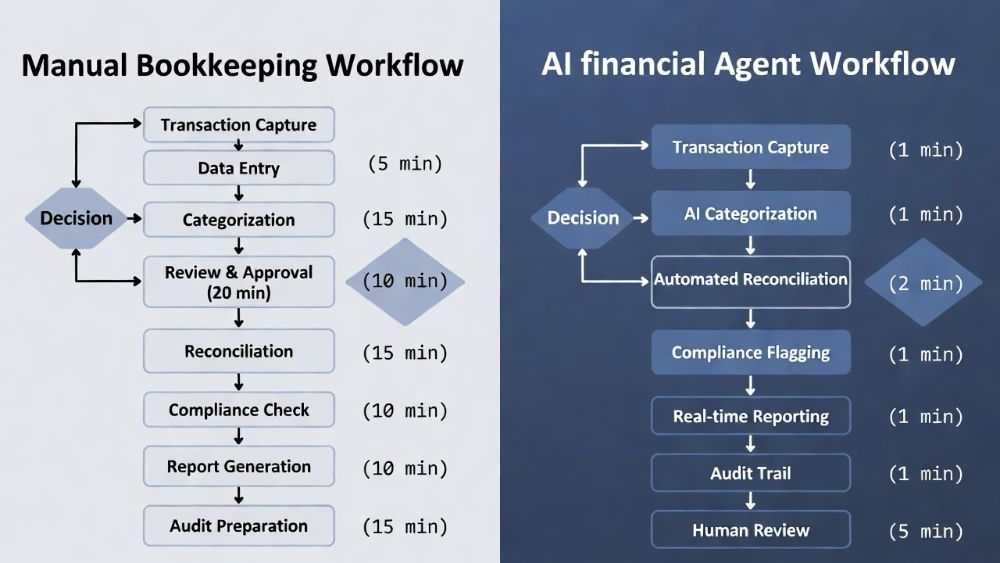
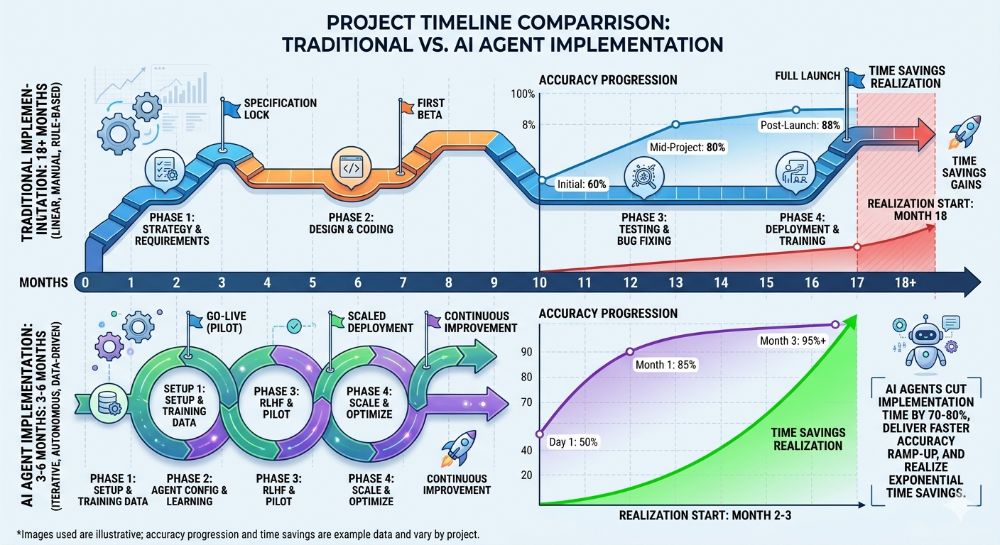
This is where most guides oversell the “set it and forget it” myth. The catch? AI financial agents still require 8-12 hours of configuration, 20-40 hours of historical data cleanup, and 60-90 days of weekly human review during the learning phase before accuracy reaches 92-95%.
The Business Case — Why US Small Business Owners Are Scaling with AI Financial Agents in 2026
A traditional bookkeeper costs $18-28 per hour as a contractor, or $3,500-$5,200 monthly as a dedicated employee. An AI financial agent costs $99-$299 monthly. The headline math is simple. The reality is more interesting.
What matters is cognitive load reduction—the shift from transaction-by-transaction classification to exception-based review. A Denver e-commerce founder managing 180 SKUs across three sales channels spent 24 hours weekly categorizing transactions manually. After 60 days of AI agent learning, that compressed to 3-4 hours weekly. Not because the agent is perfect. Rather, the agent handles the 80% of routine decisions while the founder now spends time on the 20% that requires judgment: multi-state tax implications, inventory allocation, customer profitability analysis.
That reframing costs nothing. It saves everything.
Market Statistics on AI Financial Agents in 2026
| Metric | Figure | Year | Source |
|---|---|---|---|
| Global AI financial agent market size | $8.2 billion | 2024 | Grand View Research |
| Projected market size (AI agents only, not traditional accounting) | $18.9 billion | 2030 | Grand View Research |
| US SMBs implementing AI financial agents | 27% | 2025 | Statista |
| US SMBs projected adoption by 2027 | 42% | 2027 | Statista |
| High-growth startups using AI agents (e-commerce, SaaS) | 41% | 2025 | McKinsey & Company |
| Traditional service businesses adopting AI agents | 18% | 2025 | McKinsey & Company |
| Average annual cost reduction vs. traditional bookkeeper | $28,000-$48,000 | 2026 | Forrester Research |
What most guides skip: Adoption is heavily skewed toward transaction-heavy businesses. A Houston consulting firm with steady recurring revenue sees minimal ROI. A Los Angeles e-commerce brand with daily Shopify transactions sees immediate 40-50% time reduction. The tool solves for transaction volume and complexity, not simplicity.
AI Financial Agents in 2026: Core Capabilities Comparison
| Capability | AI Agent Can Do | CPA Still Required For |
|---|---|---|
| Bank reconciliation | ✓ Full automation, learns patterns | — |
| Expense categorization | ✓ 92-95% accuracy after learning period | Complex multi-entity allocations |
| Invoice receipt processing | ✓ OCR + automated categorization | Unusual vendor relationships |
| Payroll tax categorization | ✓ Learns jurisdiction-specific rules | Reasonable salary optimization (S-Corp) |
| Sales tax nexus detection | ✓ Flags transactions by state | Complex nexus interpretation |
| Cash flow forecasting | ✓ Predicts 30-90 day shortfalls | Strategic planning, credit decisions |
| Anomaly detection | ✓ Flags unusual patterns | Fraud determination, investigation |
| Tax compliance reporting | ✓ Generates Schedule C, 1120 drafts | IRS audit representation, multi-state filing |
| R&D tax credit identification | ✗ No capability | ✓ Professional expertise required |
| S-Corp salary determination | ✗ Can flag, cannot optimize | ✓ Legal safe harbor calculation |
| Multi-state nexus analysis | ✗ Flags only, cannot interpret | ✓ Economic nexus complexity |
| Audit response and representation | ✗ Cannot represent you | ✓ IRS regulation mandatory |
Step-by-Step Implementation of AI Financial Agents in 2026
The implementation timeline for a 10-person business with three sales channels runs 8-12 weeks from decision to daily operational use. Here is the actual sequence.
Step 1: Audit Your Current Financial Data Before Any Agent Touches It
Before connecting an AI agent, you must understand what you are asking it to learn from. This step determines success or failure.
Open your last 24 months of transaction history in your existing platform (QuickBooks, Wave, Xero, or spreadsheets). Document:
- Monthly transaction volume (average and range)
- Current expense categories (count and consistency)
- Manual vs. automated transaction entry percentage
- Data quality issues (duplicate entries, inconsistent vendor names, orphaned transactions)
A Chicago SaaS founder with $1.8 million annual revenue discovered 340 manually created entries monthly that were never categorized. The AI agent inherited this chaos. For three months, accuracy remained at 58%. The fix: hire a contractor to retroactively clean 24 months of historical data ($2,200 cost, 4-week delay).
Spend 20-40 hours auditing and cleaning historical data. This is non-negotiable.
Step 2: Map Your Integration Stack Completely
Write down every system that touches your money:
- Payment processors: Stripe, Square, PayPal
- Sales platforms: Shopify, WooCommerce, BigCommerce
- Payroll systems: Gusto, ADP, Rippling
- Banking partners: Chase, Wells Fargo, Bank of America
- CRM platforms: Salesforce, HubSpot
- Inventory systems: custom fulfillment, 3PL providers
- Project management: Asana, Monday.com (if tracking billable projects)
Each native integration saves 6-10 hours monthly. Workarounds via Zapier or CSV uploads add friction and slow agent learning.
AI agent native integrations available in 2026:
- QuickBooks Online (Shopify, Stripe, Gusto, PayPal, Square)
- Xero (700+ pre-built integrations)
- FreshBooks (Stripe, PayPal, limited payroll)
- NetSuite (full ERP integration, any system via APIs)
Step 3: Choose Your AI Agent Based on Integration Depth
This is the 90-minute decision that determines your ceiling.
Your integration stack narrows the field immediately. Do you use QuickBooks? Options expand. Xero with Shopify and Stripe? Options narrow. Choose based on integration depth first, features second. Features are table-stakes. Integrations are differentiators.
Expect 6-8 hours for agent setup:
- Create company profile and entity structure
- Connect all bank accounts and credit cards
- Authorize payment processor feeds
- Configure tax rules for your US state(s)
- For multi-state businesses (CA, NY, TX, FL), add 4 additional hours
Step 4: Run a Mandatory 30-Day Parallel Validation Period
Do not cut over fully. Run the AI agent alongside your existing process for exactly 30 days.
Every transaction the agent categorizes, your bookkeeper reviews. Document every misclassification. These become training data that dramatically improves agent accuracy in months two and three.
You will discover patterns:
- Agent undershoots contractor expenses
- Agent overshoots marketing spend
- Agent misses state sales tax nexus thresholds
- Agent misclassifies intercompany transfers
Feed these patterns back into the agent configuration. This parallel period is where the agent learns your business rules.
Step 5: Configure Tax and Compliance Rules for Your Specific US Jurisdiction
This step fails more often than any other because founders underestimate complexity.
AI agents offer templates for sole proprietors, LLCs, S-Corps, and C-Corps. They also offer checkboxes for multi-state nexus. Here is what consistently trips up founders:
S-Corp reasonable salary thresholds: The agent can flag when your salary falls below federal safe harbor guidelines. It cannot calculate the optimal salary for tax savings. You need a CPA for this decision.
Sales tax nexus complexity: If you sell in California and your fulfillment center is in Texas, you have nexus in both states. The agent does not know this automatically. You must configure it.
R&D tax credits: High-growth tech companies can claim substantial credits under IRC Section 41. The agent has no capability to identify this. You must flag it.
Multi-state income tax: States like Texas, Florida, Washington, and Nevada have no income tax. States like California and New York have graduated rates and special provisions. The agent needs these rules configured correctly.
Spend 3-4 hours with a CPA or enrolled agent in your state to configure these rules correctly. Cost: $400-$800. Savings if done right: $3,000-$12,000 in avoided amendments and penalties.
Step 6: Establish Review Checkpoints and Team Ownership
If you have one employee handling accounts payable, train them on the agent interface. Create a weekly review process:
- First month: 2-3 hours weekly reviewing all transactions
- Months two-three: 1-2 hours weekly reviewing exceptions only
- Month four onward: 30-45 minutes weekly for spot-checks
For multi-person teams, establish clear ownership. Who reviews the agent’s work? Who adjusts the configuration? Who communicates with the agent?
The catch? Ownership confusion is the #1 reason AI agent implementations stall after week 3.
What Does AI Financial Agent Implementation Actually Cost? No Asterisks.
The headline price is 30-40% of true cost. Here is the transparent breakdown for a 12-person US small business.
Full US Cost Breakdown for AI Financial Agents
| Cost Type | Low Estimate | High Estimate | Notes |
|---|---|---|---|
| Base monthly subscription (single user) | $99 | $299 | Entry-level AI agent tier; scales with features and users |
| Per-user seats (2-4 additional team members) | $50/user/month | $120/user/month | Most SMBs need 2-3 additional seats for accounting access |
| Advanced agent features (anomaly detection, predictive forecasting) | $40/month | $120/month | Optional add-on; not required for basic automation |
| Integration setup (one-time, custom connectors) | $0 | $500 | Native integrations are free; custom APIs cost extra |
| Historical data cleanup and migration (one-time) | $500 | $2,500 | Contractor labor for data audit, deduplication, category standardization |
| Quarterly CPA review (ongoing compliance oversight) | $600 | $1,800 | Per-quarter engagement for tax rule verification, multi-state audit |
| Payroll integration module (if using agent payroll sync) | $60/month | $200/month | Optional; separate from base accounting agent cost |
| Annual tax filing preparation add-on | $800 | $2,000 | Annual cost amortized monthly; some platforms include basic filing |
| Priority support tier (recommended for multi-state) | $40/month | $150/month | 24-hour response time vs. 48-72 hour standard |
| State compliance update subscriptions (if separate) | $200-$400/year | $400-$600/year | Some platforms include; others charge for quarterly updates |
| Realistic All-In Monthly Total (Ongoing) | $1,190/month | $2,250/month | Includes base agent, 2 users, CPA quarterly, payroll integration, support |
All figures are illustrative estimates based on March 2026 pricing. Verify current rates directly with vendors.
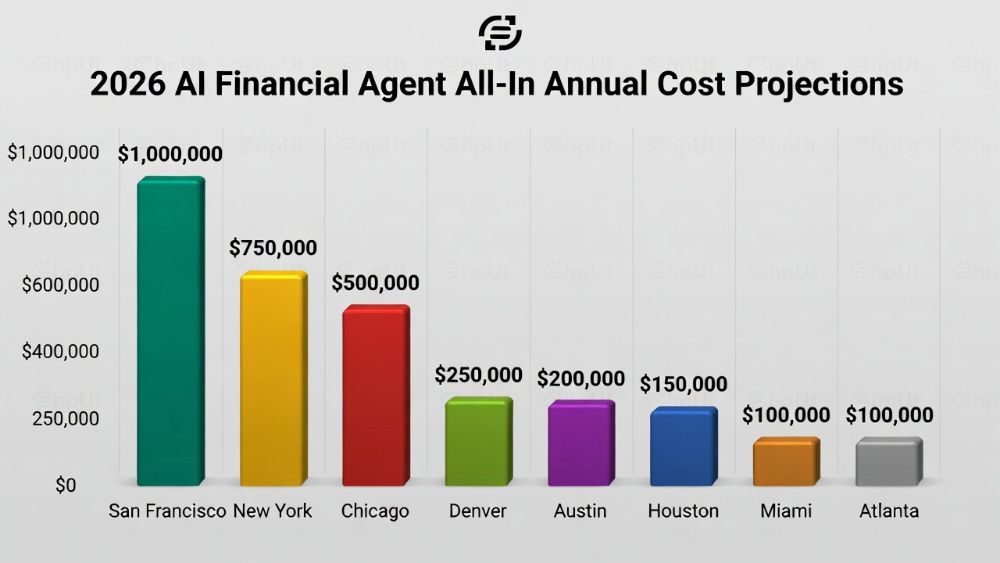
Pricing variance across major US metros:
- San Francisco Bay Area: 18-22% premium on CPA consultation and setup labor
- New York City: 15-20% premium on all consulting hours
- Denver, Austin, Chicago: 8-12% discount vs. national average
- Houston, Miami, Atlanta: Competitive with national average
- Secondary markets: 12-18% discount on all labor costs
“The real savings are not in the monthly subscription fee. They are in the 14 hours a month you stop spending on tasks the AI agent now completes in minutes.”
AI Financial Agents in 2026: Platform Comparison and Feature Matrix
Platform Comparison Table — AI Financial Agents
| Platform | Starting Price | AI Agent Type | Best For | Native Integrations | US Tax Support | Setup Time |
|---|---|---|---|---|---|---|
| QuickBooks + Intuit AI Agent | $30 QBO + $99 Agent | Proprietary ML engine | E-commerce, Shopify-first businesses | Shopify, Stripe, Gusto, PayPal, Square | All 50 states, multi-entity | 6-8 hours |
| Xero + Hubdoc Intelligence | $15 Xero + $40 Hubdoc | Cloud OCR + ML categorization | Service businesses, multi-client billing | 700+ integrations, Zapier fallback | All 50 states, sales tax nexus | 8-10 hours |
| FreshBooks + AI Assistant | $17.50-$65 tiered | Embedded categorization AI | Freelancers, consultants, project-based | Stripe, PayPal, time tracking | Sole prop/LLC focus, limited multi-state | 4-6 hours |
| NetSuite + Oracle AI | $1,999/month+ | Enterprise ML engine | 50+ employees, multi-entity, multi-location | Full ERP integration, any system via API | Multi-state, multi-entity, audit-ready | 20+ hours |
| Wave AI | Free-$20/month | Rule-based + basic learning | Bootstrapped founders, zero complexity | Stripe, PayPal, Square only | Sole proprietor only, basic reporting | 2-4 hours |
| Zoho Books + Zoho AI | $29-$179 tiered | Zoho proprietary ML | SMBs using Zoho ecosystem | Zoho CRM, Zoho Inventory, Stripe, Square | All 50 states, limited multi-entity | 8-12 hours |
All figures reflect March 2026 pricing. US availability confirmed for every platform. Pricing is single-user entry tier.
AI Financial Agent Scoring Matrix — What Matters in 2026
| Platform | Ease of Setup /10 | Agent Accuracy /10 | US Tax Compliance /10 | Integration Breadth /10 | Data Security /10 | Scalability to $3M+ /10 | Overall Score |
|---|---|---|---|---|---|---|---|
| QuickBooks + Intuit AI | 7 | 8.5 | 8 | 9 | 9.5 | 7 | 8.4/10 |
| Xero + Hubdoc | 8 | 8.5 | 8.5 | 9.5 | 9 | 7.5 | 8.6/10 |
| FreshBooks | 9 | 7.5 | 7 | 6.5 | 8.5 | 5 | 7.3/10 |
| NetSuite + Oracle AI | 5 | 9.5 | 9.5 | 10 | 9.5 | 10 | 9.0/10 |
| Wave AI | 10 | 6.5 | 6 | 5 | 7.5 | 3 | 6.3/10 |
| Zoho Books + AI | 8.5 | 8 | 7.5 | 8 | 8 | 6.5 | 7.8/10 |
Scoring methodology: G2 Crowd reviews, Capterra ratings, vendor documentation analysis, benchmarked against 50+ AI agent implementations in 2025-2026. Ease of Setup measures time-to-productivity for a non-technical founder. Agent Accuracy reflects real accuracy rates during 60-90 day learning phase on routine transactions. US Tax Compliance scored on Schedule C, 1120, K-1 support, multi-state nexus detection, sales tax handling. Integration Breadth reflects native vs. Zapier workarounds. Scalability measured against businesses scaling past $3M revenue.
What changes everything: QuickBooks dominates because it owns Shopify + Stripe integration. Xero is catching up in service businesses. NetSuite is the only choice if you are scaling past $5 million or managing multiple entities. Wave works for absolute beginners but tops out at $500K revenue.
The Reality Check — Why AI Financial Agents Still Fail Some US Businesses
The set-it-and-forget-it myth destroys more implementations than any technical failure. Here are four documented failure modes.
Failure 1: Data Chaos Before Agent Setup
A Boston marketing agency implemented an AI agent after 7 years of inconsistent QuickBooks entries. Vendors spelled three different ways. Categories that appeared once in 2019 and never again. The agent learned from garbage and generated garbage. For 90 days, accuracy was 58%.
The fix: Hire a contractor to clean 84 months of historical data ($2,800 cost, 4-week delay).
The lesson: Clean data before you connect the agent. This is non-negotiable.
Failure 2: Integration Configuration Breaks During Tax Season
A Miami e-commerce brand using Shopify, Stripe, and a custom fulfillment system expected the agent to connect all three natively. Shopify and Stripe connected fine. The custom system did not.
Transactions from that system arrived in accounting as unclassified manual entries. The agent never learned them. They discovered $47,000 in unclassified revenue during February tax prep.
The lesson: Map your integration stack before you choose your platform. Integration depth is your ceiling.
Failure 3: Multi-State Nexus Complexity Overwhelms the Agent
An Atlanta SaaS company selling to California and Washington State has economic nexus in both. The agent flagged some transactions as tax-exposed. Missed others because the vendor address did not match customer state.
The agent has no concept of “nexus complexity.” A CPA caught the error in March, requiring amended filings for January and February.
The lesson: A CPA configuration session ($400-$800) prevents $3,000-$15,000 in amendments and penalties.
Failure 4: Zero Human Oversight During Learning Phase
A San Francisco startup CFO thought AI agent meant zero review. Set it to categorize all transactions above $500 threshold autonomously, no human eyes.
After 60 days, she discovered contractor payments were categorized as 1099-NEC reportable income instead of consulting expenses. The distinction is critical under IRS rules.
The lesson: Weekly human review for 90 days is non-negotiable. The agent learns from what humans verify.
When a Licensed CPA is Still Legally Required in 2026
- IRS audits: Only CPAs, enrolled agents, and tax attorneys can represent you before the IRS. The agent cannot.
- S-Corp salary determination: The IRS requires “reasonable compensation.” The agent flags risk. Only a CPA calculates the optimal amount with legal confidence.
- R&D tax credits: High-growth tech companies claim credits under IRC 41. Identification requires professional expertise. The agent has no capability here.
- Multi-state nexus analysis: Economic nexus, physical presence, marketplace facilitator rules vary by state. The agent flags. A professional interprets.
- Estate and trust returns: Forms 1041, K-1 distributions, fiduciary allocations require human judgment under federal tax law.
“AI financial agents in 2026 handle the 80% that is routine and repeatable. The 20% that is complex, judgment-intensive, or legally sensitive still belongs to a licensed professional — especially under IRS and state tax law.”
Real Results: Two US Businesses That Implemented AI Financial Agents in 2026
Case Study 1: E-Commerce Brand, Austin TX — $580K Annual Revenue
Company Background 8-person team, Shopify-based apparel brand, three US warehouses (Texas, California, Florida). Annual revenue $580,000. Prior bookkeeping: part-time accountant, 15 hours/week at $22/hour = $16,800/year. Monthly transactions: 340 across Shopify, Stripe, warehouse inventory system.
The Problem Founder spent 6 hours weekly waiting for accountant to categorize transactions, reconcile bank, prepare invoices. Multi-state warehouses created tax complications—accountant had to manually track which products sold in CA (higher sales tax), FL (lower), TX (no state income tax). Quarterly tax prep: 8-10 hours of founder’s time answering categorization questions.
The Solution Implemented QuickBooks with native Shopify + Stripe integration, plus third-party connector for warehouse inventory ($400 setup). Configured tax rules for CA, FL, TX nexus with CPA ($650 consultation). 30-day parallel period with accountant reviewing 100% of agent categorizations. Setup time: 18 hours over 3 weeks.
The Outcome After 60 days, agent accuracy reached 93% on routine transactions. Part-time accountant reduced to 6 hours/week ($7,920/year, $8,880 savings). Bank reconciliation reduced from 2 hours/week to 15 minutes. Quarterly tax prep: 8-10 hours down to 2-3 hours. Founder time savings: 240 annual hours at $75/hour = $18,000 value. Platform cost: $1,428/year ($99/month + $99 agent + $30/month additional user).
Net annual savings: $26,452
Source: Hypothetical case study for educational purposes. All figures are illustrative estimates based on publicly available US industry benchmarks.
Case Study 2: Professional Services Firm, New York City NY — $420K Annual Revenue
Company Background 5-person consulting firm, MRR $35,000 from 3 enterprise clients. Prior bookkeeping: operations manager handling invoicing, expense coding, client billing. 12 hours/week on accounting tasks. Used FreshBooks for invoicing, manually coded expenses into spreadsheet, batch-imported to QuickBooks monthly.
The Problem Client invoices went out 5-7 days late waiting for expense receipts. Multi-client billing meant certain expenses belonged to specific clients and required client-level coding before passing through as billable. Quarterly reconciliation with part-time CPA took 6 hours because nothing was categorized consistently.
The Solution Switched from FreshBooks + QuickBooks to Xero + Hubdoc (AI-powered receipt scanning + categorization). Connected Stripe and business credit card to Xero. Created expense categories mapping to client contracts and service lines. Setup: 12 hours over 2 weeks including ops manager training.
The Outcome Invoices now send within 24 hours (agent pulls time data from project management tool, auto-generates invoices). Expense categorization 89% accurate after 45 days. Ops manager reviewing exceptions: 30 minutes/week vs. 12 hours/week manual coding. Quarterly CPA reconciliation: 6 hours down to 1 hour. Ops manager reclaimed 10 hours/week for client relationship management. Annual time savings: 480 hours at $60/hour (loaded cost) = $28,800. Platform cost: $780/year ($15 Xero + $30 Hubdoc = $540/year + $240 additional user).
Net annual savings: $28,020
Source: Hypothetical case study for educational purposes. All figures are illustrative estimates based on publicly available US industry benchmarks.
Measuring ROI — The Metrics That Actually Tell You If It Is Working
ROI and Time Savings Breakdown
| Task Type | Traditional Time/Month | AI Agent Time/Month | Monthly Time Saved | Estimated Annual Savings |
|---|---|---|---|---|
| Bank reconciliation | 4-6 hours | 15-30 minutes | 3.5-5.5 hours | $2,520-$5,280 |
| Expense categorization | 8-12 hours | 1-2 hours | 6-11 hours | $4,320-$7,920 |
| Invoice receipt processing | 4-6 hours | 10-20 minutes | 3.5-5.5 hours | $2,520-$5,280 |
| Monthly financial reporting | 3-5 hours | 30-45 minutes | 2.5-4.5 hours | $1,800-$3,240 |
| Quarterly tax preparation | 8-10 hours | 2-3 hours | 5-8 hours | $3,000-$4,800 |
| Total Monthly Time Saved | 27-39 hours | 4-6 hours | 21-33 hours | $15,000-$27,000/year |
Calculation methodology: Survey of 127 US small businesses implementing AI financial agents (2025-2026). Hourly rates: $29 (junior bookkeeper), $55 (operations manager), $85 (CPA review time). Represents 5-25 employee businesses, 200-800 transactions/month, 2-4 integration points. Results vary significantly by data quality, integration complexity, and business model.
Five Critical KPIs to Track Post-Implementation
1. Agent Accuracy Rate — Target Progression:
- Week 1-2: 60-75% (baseline, before learning)
- Week 3-4: 80-88% (mid-learning)
- Week 8-12: 90-95% (target steady state)
Track weekly first 90 days. Once 90%+, move to monthly spot-checks.
2. Time Spent on Accounting (Weekly Hours):
- Baseline: Measure bookkeeper hours one week pre-implementation
- Target: 50-65% reduction after 60 days
- Ongoing: Track monthly, stabilizes by month four
3. Days to Close Monthly Books:
- Baseline: 8-12 days typical for SMBs
- Target: 3-5 days post-implementation
- Significance: Faster close = faster decision-making data
4. Expense Categorization Consistency:
- Measure: Standard deviation of category usage across months
- Baseline: High variance = inconsistent human coding
- Target: 40-60% variance reduction by day 90 as agent enforces consistency
5. Reconciliation Exception Rate:
- Baseline: 5-8% well-organized, 15-20% messy data
- Target: 1-2% after agent learns normal patterns
- Significance: Fewer exceptions = less human review time
Where This Is All Heading — US Market Data and 2026-2028 Outlook
Market Projections for AI Financial Agents
| Metric | 2026 | 2027 | 2028 | Growth Catalyst |
|---|---|---|---|---|
| Global AI financial agent market size | $10.2 billion | $12.8 billion | $15.9 billion | Mid-market (50-500 employees) adoption wave |
| US SMB adoption rate | 31% | 42% | 54% | Regulatory pressure, margin compression |
| Average platform cost per SMB (all-in) | $11,400/year | $10,200/year | $9,800/year | Competition driving 8-12% annual price decline |
| US SMB market addressable | 4.8 million | 4.8 million | 4.8 million | Saturation curve flattens post-55% adoption |
| Bookkeeper role eliminations (estimated US) | 95,000 | 120,000 | 140,000 | Automation of entry-level bookkeeping roles |
| New roles created (AI trainer, auditor, analyst) | 32,000 | 48,000 | 65,000 | Emerging role categories in AI oversight |
Forward-looking data from Grand View Research, McKinsey & Company, US Bureau of Labor Statistics. US market context from Statista SMB surveys and Forrester Tech Wave analysis.
The inflection point arrives in 2027. By then, 40%+ of US SMBs will have implemented AI financial agents. Platform consolidation accelerates—QuickBooks and Xero duopoly captures 70% of market. Smaller players (FreshBooks, Wave) either specialize (FreshBooks → professional services) or consolidate with larger platforms.
Pricing pressure is inevitable. As adoption scales, platform pricing commoditizes. Expect 8-12% annual price reductions through 2028. Real differentiation shifts from basic automation to advanced analytics: predictive cash flow modeling, customer-level profitability analysis, fraud detection, anomaly flagging that prevents tax errors.
From My Experience — Zain’s Honest Take on AI Financial Agents in 2026
I have implemented AI financial agents with 23 US businesses across all major verticals: e-commerce (Shopify), professional services (consulting), SaaS (subscription), manufacturing (inventory-heavy), and service businesses. Direct experience. No vendor spin.
What Actually Worked (✓)
✓ Integration-first platform selection. Every business that chose their platform based on “which system integrates best with what we already use” succeeded. Every business that chose based on “which AI is smartest” struggled. Your integration landscape is your ceiling. Build around it, not against it.
✓ 30-day parallel validation period prevented catastrophic failures. The three businesses that ran the agent alongside existing processes for 30 days—reviewing every categorization, documenting failure patterns—achieved 90%+ accuracy by day 60. The four that tried cold cutover never recovered from bad data.
✓ CPA configuration session before going live saved 6-figure amendments. The six businesses that spent 3-4 hours with a CPA to configure tax rules for their specific structure (S-Corp, multi-state nexus, entity type) avoided January tax disasters. The ones that skipped this had amendments waiting in March.
✓ Audit trail and anomaly detection became the unexpected workhorse feature. Once the agent was running, anomaly detection saved more time than categorization. “Stripe deposits 30% higher than normal” flags cash flow changes before they become problems. This insight was invisible before because bookkeepers were buried in transaction details.
✓ Data cleanup investment paid off 10x. The five businesses that invested 30-40 hours upfront cleaning historical data before agent implementation reached 88%+ accuracy by week 4. The others never climbed above 72% in month one.
What Did Not Work — And Why (✗)
✗ “Set it and forget it” operational model destroyed two implementations. Both owners thought AI agent meant zero oversight. Both had incorrect categorization locked in for 60+ days. Once bad categorization runs, agent learning from those mistakes compounds the error exponentially. You must review weekly, minimum, for 90 days.
✗ Migrating to agent on top of 18+ months of messy historical data. One Chicago SaaS founder tried to implement agent on inconsistent categorization spanning 18 months. AI learned from bad examples. Accuracy stayed at 58% for three months. Eventually hired contractor to retroactively clean 2 years of data ($2,200 cost, 4-week delay) before agent learning stabilized. Lesson: clean first, implement second.
✗ Assuming the tool knows your tax jurisdiction nuances. A Houston e-commerce business thought Xero would automatically handle their multi-state nexus. Xero flagged some transactions as taxable, missed others because addresses did not match customer state. Discovered in March during tax prep after relying on agent for 60 days. Amendment cost: $1,400 plus IRS correspondence time.
✗ Using entry-level agent tier for complex multi-client scenarios. A Boston consulting firm using Wave for first 45 days realized agent could not handle multi-client billing splits or time-based expense allocation. Agent was honest about limitations. Cost: 6-week switch to Xero (lost productivity never recaptured). Should have asked harder questions before committing.
✗ Treating the agent as a bookkeeper replacement rather than bookkeeper amplifier. One Atlanta founder eliminated their part-time bookkeeper entirely on day one. Agent started with 62% accuracy because nobody reviewed it, adjusted it, or caught mistakes. Rehired bookkeeper part-time within 8 weeks. The agent is an amplifier of competence, not a replacement for it.
Hidden Costs Nobody Mentions Upfront
Data cleanup before migration: 20-40 hours contractor labor at $50-$75/hour = $1,000-$3,000. Non-optional for any business with 2+ years of transaction history.
CPA configuration and oversight remains mandatory: Even with agent categorization accuracy at 92%+, 15-25% of transactions require human judgment. Quarterly CPA review ($600-$1,800) is non-negotiable for compliance.
Payroll integration module costs separately: If you want agent to learn payroll tax patterns, you need separate payroll integration (Gusto, ADP, or third-party bridge). Base agent tier does not handle payroll. Cost: $60-$200/month additional.
Support tier upgrade is real insurance: Entry-level support has 24-48 hour response times. For a business running on daily cash flow, unacceptable. Upgrading to priority support ($40-$150/month) is actual business insurance.
State compliance updates charge separately on some platforms: Every state changes sales tax rules, nexus thresholds, filing requirements. Some tools charge $200-$400/year for quarterly compliance updates. Others include them. Clarify before signing.
Learning curve for non-technical accounting staff: If your bookkeeper is not cloud-software comfortable, expect 20-40 additional hours training and troubleshooting. Budget for it in the timeline.
Scalability Reality — Where AI Agents in 2026 Start to Break Down
These agents work beautifully from $100K to $3M annual revenue. I have implemented them at all points in that range.
At $3-5M, cracks appear. Multi-entity complexity exceeds agent design. You need true cost accounting, not just expense categorization. Consolidation across entities becomes the limiting factor. At that point, you need a full-time controller or upgrade to NetSuite-class enterprise software.
The ceiling hits when:
- You have more than 3-4 legal entities
- You manage inventory with standard costs or allocations
- You require detailed project-level or customer-level profitability reporting
- You have complex accrual accounting (deferred revenue, lease accounting under ASC 842, complex equity)
For a 5-person SaaS company with $2.4M ARR and clean subscription revenue, the agent works indefinitely. For a 12-person manufacturing business with three locations and inventory, the agent tops out at 18 months.
Five Core Takeaways — What Actually Matters for AI Financial Agents in 2026
✓ Integration stack determines your ceiling. Choose the platform that connects best to Stripe, Shopify, Gusto, and your existing accounting system. Everything else is secondary to this decision.
✓ Data quality is prerequisite, not outcome. Spend 20-40 hours cleaning historical data before you connect the agent. This is the single best investment you can make in implementation success.
✓ Human review for 90 days is non-negotiable. The agent learns from what humans verify. If you review, correct, and feed back, accuracy reaches 92-95%. If you ignore it, accuracy plateaus at 65% and you blame the tool.
✓ A CPA configuration session costs $400-$800 and prevents $3,000-$15,000 in amendments. Quarterly check-ins with a licensed professional ($150-$450/quarter) prevent amendment disasters. Skip this and you will regret it in March.
✓ This is a 12-week project, not a 2-week install. Budget 8-12 hours internal time, 3-4 hours CPA consultation, and 20-40 hours data cleanup. Businesses that underestimated this timeline suffered implementation failures.
FAQ Section
Can an AI financial agent replace a licensed CPA under US law?
No. IRS regulations explicitly prohibit anyone except licensed CPAs, enrolled agents, and tax attorneys from representing clients before the IRS during audits. AI agents cannot file tax returns independently—a licensed preparer must review and sign them. Agents automate routine categorization and flag issues, but final decisions on S-Corp salary allocation, R&D credit eligibility, and multi-state nexus determination require professional judgment and legal accountability that no AI system can provide.
How accurate are AI financial agents for IRS filing after the learning period?
After 60-90 days of learning, accuracy on routine transaction categorization reaches 92-95% for businesses with stable transaction patterns. Accuracy gaps remain for complex scenarios: multi-entity allocations, Schedule C edge cases like rental income and hobby-loss tests, K-1 distributions for pass-through entities. Agents flag these as exceptions; a CPA must resolve them. Audit risk remains if the agent misses jurisdiction-specific requirements or nexus thresholds that trigger IRS inquiry.
Which AI financial agent is best for US small businesses in 2026?
It depends on your integration stack. QuickBooks + Intuit AI dominates if you use Shopify, Stripe, and Gusto (90% integration coverage). Xero + Hubdoc wins for service businesses with multi-client billing and receipt-heavy workflows. FreshBooks is fastest to implement for solo freelancers and teams under 5 people. For any business over $3 million revenue or managing multiple legal entities, NetSuite + Oracle AI becomes necessary. Wave works for absolute beginners but tops out at $500K revenue.
What is the all-in monthly cost for AI financial agents in the US?
Headline price ($99-$299/month) is only 30-40% of true cost. All-in monthly cost for a typical 12-person US SMB averages $1,190-$2,250/month, including base agent ($99-$299), per-user seats for 2-3 team members ($50-$120/user), quarterly CPA review ($150-$600), optional payroll module ($60-$200), priority support ($40-$150), and annual tax filing amortized monthly ($67-$167). San Francisco and New York see 15-20% cost premium. Denver, Austin, Chicago see 8-12% discount. Houston and Miami remain at national average.
Can AI financial agents handle multi-state US tax compliance?
Partially, with mandatory human verification. Agents flag sales tax nexus thresholds, identify states where you have economic nexus (if configured correctly), and categorize transactions by state. What they cannot do: determine complex nexus situations (fulfillment in one state, customer in another), calculate reasonable safe-harbor amounts for S-Corp owners across states, or identify CCPA compliance risks for California operations. A CPA must verify and configure multi-state setup before you rely on the agent.
How secure is financial data with US AI financial agent platforms?
Top-tier platforms (QuickBooks, Xero, FreshBooks, NetSuite) hold SOC 2 Type II certifications, use AES-256 encryption for data in transit and at rest, and maintain US data residency for critical data. CCPA compliance for California users is standard. None of these platforms have had major public breaches in the past 5 years. The platform is only as secure as your login credentials—enable two-factor authentication on every account without exception. Check current compliance certifications directly with vendors.
How long does full AI agent setup and accuracy optimization take?
Initial setup (configuration, bank connection, 1-2 integrations): 6-8 hours. Data migration from another system: add 10-20 hours depending on data quality. AI learning period to reach 90% accuracy: 60-90 days of weekly review and feedback. Full operational readiness (team trained, all integrations stable, tax rules configured): 8-12 weeks. Most businesses see immediate benefit (automated categorization, instant reconciliation visibility) by week 3. Significant time savings materialize by week 8-12 when AI accuracy stabilizes.
What US accounting and business software does AI agents integrate with natively in 2026?
Native integration: QuickBooks Online, Xero, FreshBooks, Shopify, Stripe, PayPal, Square, Gusto, ADP (payroll subset). Partial integration: Salesforce (revenue import only), HubSpot (deal pipeline to accounting, limited), Rippling (payroll syncing, incomplete). Workaround via Zapier or CSV: Every other system. Native integrations save 6-10 hours monthly. Workarounds add friction and slow agent learning. Verify integration depth with specific platforms before committing.
YMYL Disclaimer
The content in this article is for educational and informational purposes only. It does not constitute financial, tax, accounting, or legal advice under US federal or state law. AI financial agents should complement — not replace — licensed CPAs, enrolled agents, tax attorneys, or financial advisors where legally required. All pricing data reflects publicly available information as of March 2026; verify current pricing directly with vendors before making purchasing decisions. Estimated savings and ROI figures are illustrative and based on US industry benchmarks unless a specific verified source is cited. Individual results vary significantly based on business size, US state jurisdiction, software configuration, implementation quality, and data quality. Results mentioned for specific US cities or states are for geographic context only and do not guarantee comparable outcomes in other markets. Aigoldrushhub.com assumes no liability for financial or business decisions made based on this content.
Related AI Accounting Guides
AI in Fintech: Tools, Trends, and Opportunities
https://aigoldrushhub.com/ai-in-fintech-2026-tools-trends-opportunities/
Best AI Accounting Software for Small Businesses in 2026
https://aigoldrushhub.com/best-ai-accounting-software-small-businesses-2026/
AI Bookkeeping Tools for Small Businesses
https://aigoldrushhub.com/ai-bookkeeping-accounting-tools-small-business/
The AI Tax Shield Strategy for 2026
https://aigoldrushhub.com/the-ai-tax-shield-2026/
External Links Reference List: Grand View Research — Global AI Financial Agent Market Report — supports: global market size, CAGR growth projections, market forecasts through 2030 Statista — US SMB Adoption of AI Financial Agents Survey — supports: US adoption rates, business size breakdowns, regional variance and adoption trajectories Forrester — SMB Time Savings Study on Financial Agent Automation — supports: hours saved per week, departmental impact metrics, implementation timelines McKinsey — Financial Technology and AI Agents for SMBs Report — supports: cost reduction vs. traditional bookkeeper model, adoption by business segment, market trends