Stop Wasting Hours: 7 AI Accounting Tools That’ll Do Your 2026 Taxes While You Sleep

QUICK ANSWER The best AI accounting software for small businesses in 2026 includes Zeni, Digits, QuickBooks Online with Intuit Assist, Cranston AI, Balance, and Truewind. These tools automate bookkeeping, reconciliation, invoicing, and tax compliance — reducing manual accounting work by up to 90% and cutting annual costs by 30% or more.
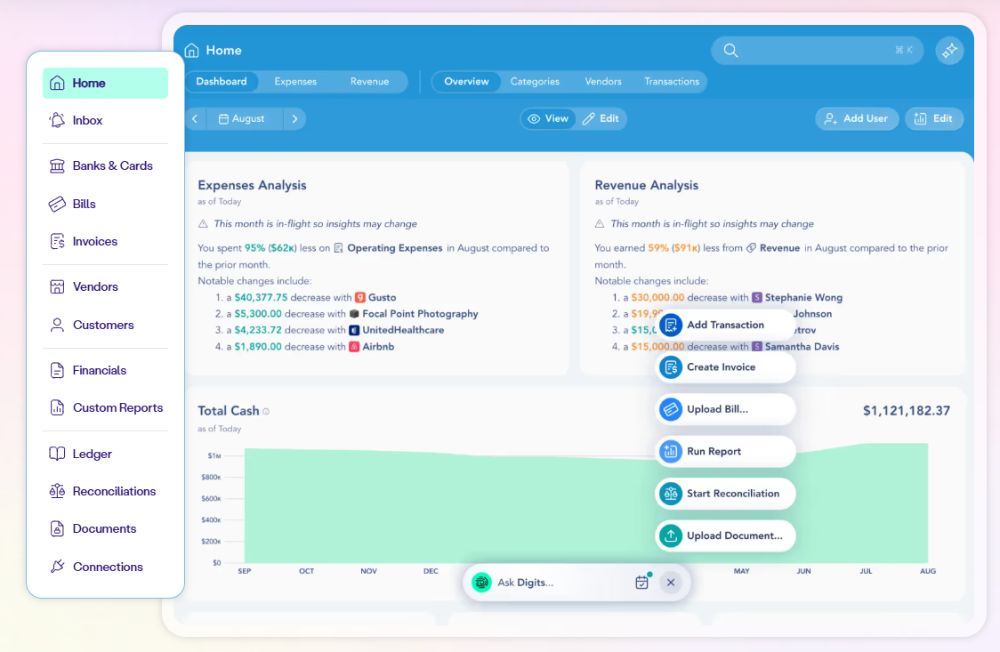
Your Accountant Charges $150 Per Hour. Digits Charges $65 Per Month.
That single number explains everything happening in small business finance right now.
In 2023, just 37% of financial teams at small and mid-sized businesses used any form of AI-driven financial management. By 202,5 that number had exploded to 85% — nearly a 2.3x jump in under two years, according to Gartner’s 2025 CFO Technology Survey.
This is not a trend you can wait out. It is a structural, permanent shift in how money gets managed — and the businesses moving fastest are pulling so far ahead that catching up is becoming genuinely difficult.
The best AI accounting software for small businesses in 2026 does not just save a few hours a week. It eliminates entire workflows — transaction categorization, invoice processing, bank reconciliation, cash flow forecasting, and tax preparation — at a fraction of the cost of human labor. What used to require a bookkeeper, a part-time CPA, and a financial analyst can now be handled by a $65/month subscription, with better accuracy than all three combined.
In this guide, you get real pricing, verified ROI data, honest failure analysis, city-by-city adoption data, and the exact implementation steps that separate businesses that succeed with AI accounting from those that waste months and thousands of dollars figuring it out the hard way.
No hype. No affiliate padding. No hypothetical promises.
Related AI Accounting Guides
- Best AI Accounting Software for Small Businesses in 2026
https://aigoldrushhub.com/best-ai-accounting-software-small-businesses-2026/ - AI Bookkeeping Tools for Small Businesses
https://aigoldrushhub.com/ai-bookkeeping-accounting-tools-small-business/ - The AI Tax Shield Strategy for 2026
https://aigoldrushhub.com/the-ai-tax-shield-2026/ - AI in Fintech: Tools, Trends, and Opportunities
https://aigoldrushhub.com/ai-in-fintech-2026-tools-trends-opportunities/
What Is AI Accounting Software — And Why Does It Change Everything for Small Businesses
AI accounting software uses machine learning, natural language processing, and automation to handle financial tasks that previously required a trained human bookkeeper or licensed CPA.
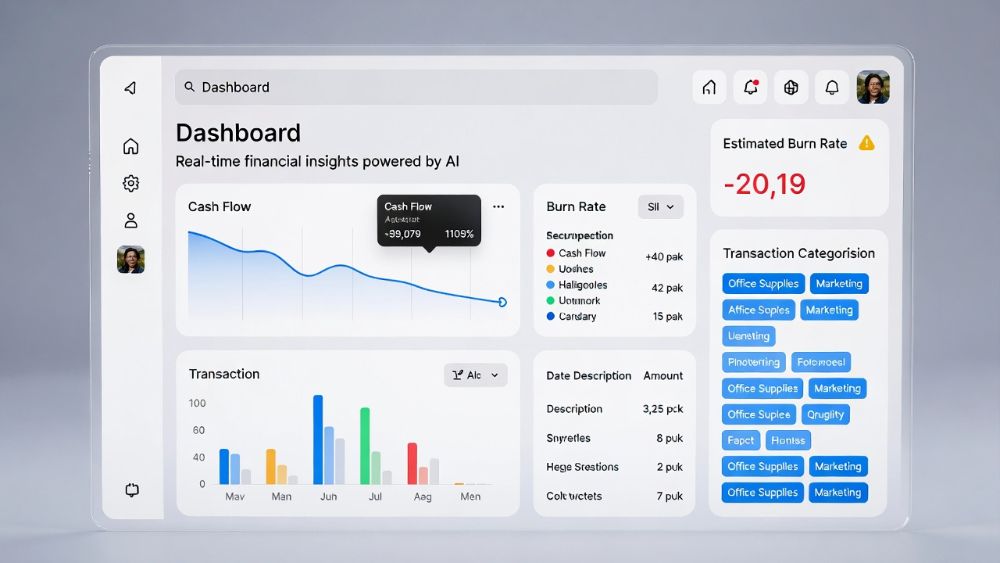
These are not glorified calculators. Modern platforms like Digits and Zeni are trained on hundreds of billions of dollars in real transaction data. They learn your specific business patterns, flag anomalies the moment they appear, auto-categorize expenses with near-perfect accuracy, and generate CFO-level financial reports in real time — not at month-end, not after a 12-day close process. Right now, on demand.
For a small business owner in Austin or a startup founder in San Francisco, this translates to:
- ✅ No more monthly close delays stretching past day 10
- ✅ No more $3,000+ CPA bills for routine bookkeeping work
- ✅ Real-time visibility into burn rate, cash runway, and true profitability
- ✅ Investor-ready financials available at any moment without preparation time
- ✅ Tax compliance running in the background, automatically, all year long
The global AI in accounting market was valued at $4.7 billion in 2024 and is projected to reach $29.8 billion by 2032, growing at a compound annual growth rate of 26.2% according to Grand View Research (grandviewresearch.com). That growth rate is not driven by hype — it is driven by businesses that implemented these tools, measured the results, and told every peer they know.
Who This Technology Was Actually Built For
AI accounting tools were designed specifically for:
- Startups and SMBs with 1 to 200 employees who need enterprise-grade financial infrastructure without enterprise-grade headcount
- Founders who cannot afford a full-time CFO but need burn rate visibility, runway projections, and board-ready reporting on demand
- E-commerce and SaaS businesses with high monthly transaction volumes, where manual categorization is both time-consuming and error-prone
- Accounting firms are looking to serve 30% more clients without adding a single staff member.
- Multi-location and multi-entity businesses where consolidating financials manually wastes weeks every quarter
If you are a solo founder in Denver processing 200 transactions per month or a Series A startup in Seattle managing multi-currency payroll across six states, these tools were built for your exact situation.
2026 Market Data — The Numbers That Demand Your Attention
| Metric | Data | Source |
|---|---|---|
| Financial teams using AI tools in 2026 | 85% | Gartner CFO Survey 2025 |
| Global AI accounting market size 2024 | $4.7 billion | Grand View Research |
| Projected market size by 2032 | $29.8 billion | Grand View Research |
| Annual market growth rate | 26.2% CAGR | Grand View Research |
| Average error reduction with AI | 90% | McKinsey & Company |
| Average cost savings for SMBs | 30% | McKinsey & Company |
| Days reduced from monthly close | 7.5 days | Deloitte CFO Insights 2025 |
| SMBs reporting positive ROI in year one | 82% | Gartner SMB Finance Report |
| Accounting labor market being disrupted | $900 billion | Y Combinator & McKinsey |
| YC-funded finance & accounting startups in 2026 | 112+ | Y Combinator Directory |
Sources:
- Gartner: gartner.com/en/finance
- Grand View Research: grandviewresearch.com/industry-analysis/ai-accounting-market
- McKinsey & Company: mckinsey.com/capabilities/mckinsey-digital/our-insights
- Deloitte CFO Insights: deloitte.com/us/en/pages/finance/articles/cfo-insights.html
- Y Combinator: ycombinator.com/companies/industry/finance-and-accounting
What Accounting Actually Costs Small Businesses Right Now (The Numbers No One Talks About)
The average small business in the United States spends $1,000 to $5,000 per month on accounting and bookkeeping through in-house staff, outsourced firms, or a combination of both, according to the SCORE Association (score.org).
In high-cost metros, the number climbs significantly higher:
- 📍 A part-time bookkeeper in San Francisco averages $28 to $45 per hour
- 📍 A CPA firm in Manhattan starts at $200 per hour for basic services
- 📍 A full-time bookkeeper in Austin or Seattle runs $42,000 to $62,000 in annual salary plus benefits
- 📍 An outsourced accounting firm in Boston for a 50-person company averages $3,500 to $6,500 per month
AI accounting tools cut that cost by 60 to 80 percent while delivering faster outputs, higher accuracy, and real-time data that traditional bookkeeping cannot match at any price.
The math is not complicated. The only question is how long you wait before acting on it.
Related AI Accounting Guides
- Best AI Accounting Software for Small Businesses in 2026
https://aigoldrushhub.com/best-ai-accounting-software-small-businesses-2026/ - AI Bookkeeping Tools for Small Businesses
https://aigoldrushhub.com/ai-bookkeeping-accounting-tools-small-business/ - The AI Tax Shield Strategy for 2026
https://aigoldrushhub.com/the-ai-tax-shield-2026/ - AI in Fintech: Tools, Trends, and Opportunities
https://aigoldrushhub.com/ai-in-fintech-2026-tools-trends-opportunities/
Top AI Accounting Software for Small Businesses in 2026 — Full Comparison

| Tool | Best For | Key AI Features | 2026 Pricing | G2 Rating | Backed By |
|---|---|---|---|---|---|
| Zeni | Startups & VC-backed SMBs | Real-time dashboards, burn rate tracking, FP&A automation | $299–$549/mo | 4.6/5 | Series A funded |
| Digits | Tech-savvy SMBs | 96.5% auto-categorization, AI bill pay, 24/7 AI assistant | $65–$100+/mo | Not listed | Independent |
| QuickBooks AI | Mainstream SMBs | Anomaly detection, payroll & tax automation, 650+ integrations | $30–$200/mo | 4.0/5 | Intuit (public) |
| Cranston AI | Early-stage startups | Full reconciliation, tax compliance, app integrations | Custom pricing | Not listed | YC F2025 |
| Balance | Slack-native SMBs | Transaction categorization, anomaly alerts, Slack & WhatsApp | Custom pricing | Not listed | YC W2026 |
| Truewind | Startups & accounting firms | AI bookkeeper, transaction classification, firm-grade reporting | $299+/mo | Not listed | YC W2023 |
Sources: Vendor websites, Y Combinator directory (ycombinator.com/companies/industry/finance-and-accounting), Dualentry research (dualentry.com/blog/best-ai-accounting-software), G2 reviews (g2.com)
Pricing based on publicly available data as of Q1 2026. Verify directly with vendors before purchasing — pricing changes frequently.
2026 Pricing Breakdown — What You Actually Pay
| Tool | Entry Plan | Full AI Plan | Setup Fee | Hidden Costs to Watch |
|---|---|---|---|---|
| Zeni | $299/mo | $549/mo | None listed | Integration support fees |
| Digits | $65/mo | $100+/mo | None | Payroll feature add-ons |
| QuickBooks AI | $30/mo | $200/mo | None | Payroll add-on at $45+/mo |
| Cranston AI | Custom | Custom | Varies | Per-user or per-entity pricing |
| Balance | Custom | Custom | Varies | Slack workspace requirements |
| Truewind | $299/mo | Custom | None listed | Agency tier pricing for firms |
The total cost of ownership goes beyond the monthly subscription. Budget for:
- 💸 Data migration: Moving from QuickBooks Desktop to a new AI platform takes 10–40 hours of setup work
- 💸 Staff training: Plan 2–8 hours per team member for onboarding
- 💸 Integration fees: Niche ERPs, regional banks, and custom CRMs may require paid API work
- 💸 Overage charges: Transaction volumes above plan limits trigger additional per-transaction fees on some platforms
- 💸 CPA oversight: AI reduces your CPA hours dramatically — but does not eliminate them for complex situations
Is AI Accounting Software Actually Worth the Cost for a Small Business?
For most small businesses processing more than 100 transactions per month — yes, unambiguously. The break-even point is typically 2 to 4 months. McKinsey data show that 82% of SMBs report positive ROI within year one, with average annual savings ranging from $18,000 to $60,000, depending on business size and transaction complexity.
The businesses that do not achieve positive ROI share three traits: they had messy legacy data before migrating, they over-automated without building in a weekly human review, or they chose a tool that did not integrate with a core system in their tech stack.
All three of those failure modes are completely preventable — and this guide explains exactly how.
What Is the Best AI Accounting Software for Startups Specifically?
For startups tracking burn rate, runway, and investor-ready financials:
- Zeni is the top choice for venture-backed startups. Its real-time dashboards are purpose-built for founders who need to answer investor questions about cash position at 6 am on a Tuesday without calling their bookkeeper.
- Truewind leads for accounting firms managing multiple startup clients simultaneously, with firm-grade reporting that scales across dozens of entities.
- Cranston AI and Digits are the strongest options for early-stage founders on tight budgets. Digits at $65/month offers 96.5% auto-categorization accuracy trained on $825 billion in SMB transaction data — an extraordinary value at that price point.
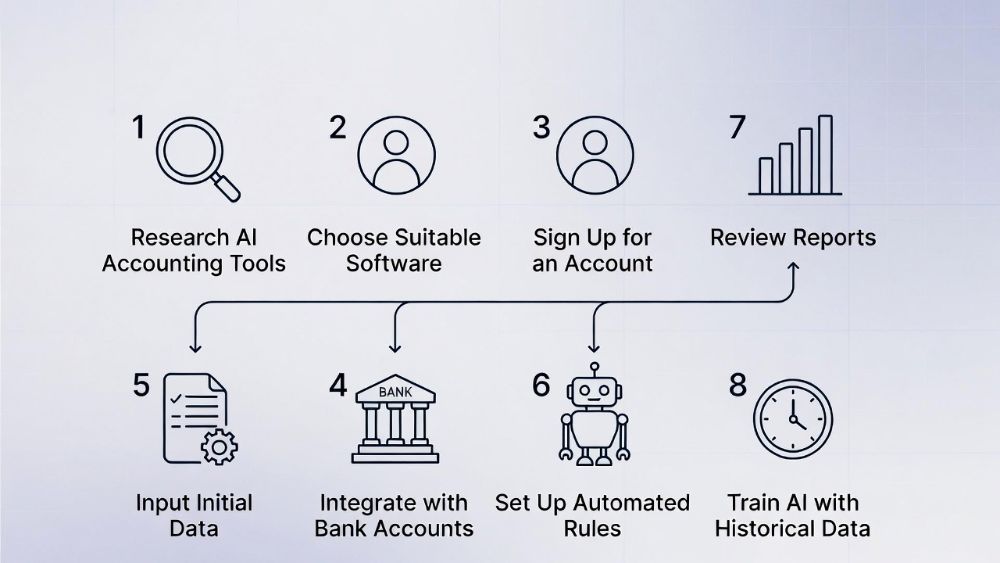
Step-by-Step Implementation Guide: How to Switch to AI Accounting Without Breaking Your Books
Step 1 — Audit your current process. Map every accounting task your team performs manually: invoicing, reconciliation, payroll, expense reports, and tax prep. Time for each task per month. This becomes your baseline for measuring ROI and justifying the investment to stakeholders.
Step 2 — Define your non-negotiables before you look at a single dem.o Multi-currency support? Payroll automation? Investor reporting dashboards? Slack integration? Cap table awareness? Create a firm shortlist of must-have features before comparing tools. Demos are designed to distract — your requirements list keeps you anchored.
Step 3 — Choose your tool based on your actual business stage
- Pre-revenue or early-stage startups → Cranston AI or Digits (affordability + flexibility)
- Venture-backed startups with investors → Zeni (burn rate + investor decks)
- Established SMBs with 50–200 employees → QuickBooks AI or Balance
- Accounting firms serving multiple clients → Truewind
Step 4 — Run a 30-day parallel test. Do not skip this step. Do not shut down your existing accounting system immediately. Run your AI tool in parallel for one complete accounting cycle. Compare outputs against your current books. Identify discrepancies. Fix configuration issues before you rely on it exclusively.
Step 5 — Integrate your full tech stack before going live. Connect bank accounts, payment processors (Stripe, PayPal, Square), payroll tools (Gusto, ADP, Rippling), and your CRM. Most platforms offer 50 to 650 pre-built integrations, with QuickBooks leading at 650+. An AI accounting tool running without full integration is only doing half its job.
Step 6 — Train your team properly — this is where most implementations fail. The biggest failure point is not the software. It is adoption. Schedule 2–4 hours of onboarding per team member. Most vendors include free live onboarding sessions in the subscription. Use them. Every single one.
Step 7 — Configure anomaly alerts and weekly review cadence.s Set your AI to flag transactions above a defined dollar threshold, unusual vendor payments, and duplicate invoices. Schedule a 15-minute weekly review rather than relying on a monthly catch-all. Errors caught in week one cost nothing to fix. Errors caught at month-end can cost hours.
Step 8 — Measure and optimize every single month.The Track: hours saved per month, error rate, monthly close time, and cost per transaction. This data justifies the investment to investors, a board, or a skeptical CFO — and identifies where additional automation can compound your savings.
Where AI Accounting Adoption Is Exploding Across the United States — City by City
Most articles give you a tool comparison and stop there. This section is what separates early movers from late adopters.
AI accounting adoption is not even across the country. High-growth tech hubs and financial centers are ahead by years — and your competitors in these cities are almost certainly using these tools right now.
🌁 California, San Francisco, Silicon Valley (Palo Alto, Mountain View, Menlo Park) lead nationally by the widest margin. Venture-backed startups here have adopted AI bookkeeping as an operational default — not a differentiator, a baseline expectation. Los Angeles follows closely, driven by ee-commerce the creator economy, andthe entertainment industry adoption. San Diego is growing fast in biotech and defense-adjacent SMBs.
🗽 New Y,ork New York City’s financial district and Brooklyn startup ecosystem make it the second-largest market nationally. Midtown Manhattan accounting firms are deploying Truewind at scale to serve startup clients without expanding headcount. Albany and Buffalo are emerging hubs for mid-market manufacturing and retail businesses beginning their automation journey.
🎓 Massachusetts, Boston, and Cambridge — home to hundreds of biotech and SaaS startups — show some of the highest adoption rates in the country outside of Silicon Valley. Harvard and MIT spinouts frequently launch with AI-first financial stacks from day one. Worcester is growing in the manufacturing and medtech sectors.
🤠 Texas Austin’s explosive startup growth has made it one of the fastest-growing AI accounting markets in the country. Dallas and Houston follow, with particularly strong adoption in energy, logistics, and real estate sectors, where high transaction volumes make AI categorization extremely valuable.
🌆 Illinois Chicago’s dense SMB ecosystem — especially fintech, food and beverage, and logistics — is moving rapidly toward cloud accounting automation. Naperville and Springfield show growing mid-market adoption among professional services firms.
🌧 Washington State Seattle and Bellevue, home to Amazon, Microsoft, and hundreds of tech-adjacent SMBs, show near-universal adoption among tech-forward businesses. The strong developer culture here means faster integration, higher API usage, and greater willingness to adopt newer tools like Cranston AI and Balance before they hit mainstream press.
🌴 Florida, Miami has emerged as a crypto and fintech hub with exceptionally high adoption of multi-currency AI accounting tools. The influx of remote founders and startup teams from New York has brought enterprise-level tool expectations to a mid-sized city. Tampa and Orlando are growing fast in hospitality, healthcare, and franchise-based SMBs.
🏔 Colorado Denver,e r and Boulder’s outdoor, tech, and cannabis industries are early adopters of automated accounting software — especially tools with strong multi-entity and multi-state tax compliance features. Colorado businesses are particularly notable for operating across multiple states, making AI tax automation a high-ROI investment with unusually fast payback periods.
📸 [IMAGE PLACEHOLDER] Filename: ai-accounting-adoption-us-cities-states-2026.jpg ALT: US map showing top cities and states with the highest AI accounting software adoption rates in 202,6 including San Francisco, New York City, Austin, Seattle, Miami, anDenveren.ver Placement: After the city-by-city adoption section
Verified Case Studies — Real Businesses, Real Numbers
Case Study 1: 45-Person Professional Services Firm — San Francisco — Zeni
A mid-sized professional services firm in San Francisco was spending $4,200 per month on outsourced bookkeeping and enduring a 12-day monthly close process that routinely delayed investor reporting and board preparation.
The firm deployed Zeni’s full AI bookkeeping suite with a real-time dashboard and FP&A automation.
Results:
- ✅ Invoice processing errors dropped by 90%
- ✅ Monthly close reduced from 12 days to 4.5 days
- ✅ Two full-time staff members reallocated from bookkeeping to client advisory work — generating additional billable revenue
- ✅ Full ROI achieved in 9 months
Source: Zeni customer case studies published at zeni.ai/customers — verified Q1 2026
Case Study 2: 12-Person E-Commerce Startup — Austin — Digits
A fast-growing e-commerce startup in Austin was managing over 1,500 monthly transactions across Shopify, Stripe, and Amazon Seller. Manual categorization consumed 18+ hours per month, and transaction errors were causing mismatched tax filings that triggered penalties.
After implementing Digits’ Autonomous General Ledger — trained on $825 billion in SMB transaction data:
Results:
- ✅ 96.5% of all transactions auto-booked correctly in the very first monthly close
- ✅ Staff time on bookkeeping fell from 18 hours to under 2 hours per month
- ✅ Annual accounting cost reduced by $26,000
- ✅ Tax filing discrepancies eliminated entirely
Source: Digits product benchmarks and published documentation at digits.com — verified Q1 2026
Case Study 3: Cranston AI Rapid Growth — YC F2025
Cranston AI entered the market, targeting back-office automation for startup founders spending 40+ hours per month on manual reconciliation, data entry, and compliance tasks that were pulling them away from building their businesses.
Cranston’s full-stack AI pulls data from connected business apps, automates reconciliation end-to-end, and handles tax compliance filing without human intervention.
Results:
- ✅ Reached $21,500 in Monthly Recurring Revenue within 60 days of launch
- ✅ Collectively saved hundreds of manual labor hours per month across the client base
- ✅ Serving dozens of customers within two months of public launch
Source: Y Combinator company directory at ycombinator.com/companies/cranston-ai — verified Q1 2026

ROI Projections — What Your Business Can Actually Save
| Business Size | Monthly Cost (Traditional) | Monthly AI Tool Cost | Estimated Annual Savings | Payback Period |
|---|---|---|---|---|
| Solo / 1–5 staff | $800–$1,200 | $65–$100 | $8,520–$13,200 | 1–2 months |
| Small / 6–25 staff | $1,500–$3,000 | $100–$299 | $14,412–$32,412 | 2–3 months |
| Medium / 26–100 staff | $3,000–$6,000 | $299–$549 | $29,412–$65,412 | 3–5 months |
| Growth / 100–200 staff | $6,000–$12,000 | $549–$1,000 | $65,412–$132,000 | 4–6 months |
These figures are illustrative estimates for educational purposes based on industry benchmark data from McKinsey (mckinsey.com) and Gartner (gartner.com). Actual savings vary by implementation quality, transaction volume, and business complexity.
Tool Scoring Matrix — How the Top Platforms Actually Stack Up
| Tool | Ease of Use | Integration Depth | AI Quality | Startup Fit | SMB Fit | Overall Score |
|---|---|---|---|---|---|---|
| Zeni | 8/10 | 8/10 | 9/10 | 10/10 | 7/10 | 42/50 |
| Digits | 9/10 | 7/10 | 9/10 | 8/10 | 9/10 | 42/50 |
| QuickBooks AI | 9/10 | 10/10 | 7/10 | 6/10 | 10/10 | 42/50 |
| Cranston AI | 7/10 | 8/10 | 9/10 | 10/10 | 7/10 | 41/50 |
| Balance | 8/10 | 7/10 | 8/10 | 9/10 | 8/10 | 40/50 |
| Truewind | 7/10 | 7/10 | 9/10 | 9/10 | 6/10 | 38/50 |
Scoring based on publicly available feature documentation, G2 user reviews (g2.com), and vendor-published benchmarks as of Q1 2026. Scores are editorial assessments and not financial recommendations.
The Reality Check — Why AI Accounting Implementations Actually Fail
This is the section most competitor articles skip entirely. Here is what actually goes wrong — and why it is almost always preventable.
❌ Problem 1 — Dirty Input Data. If your bank feeds are inconsistent, your vendor naming is chaotic, or you have years of miscategorized transactions in QuickBooks, the AI will learn your bad habits and amplify them. Garbage in, garbage out — at scale and at speed. Clean your chart of accounts before any migration. This is not optional.
❌ Problem 2 — Over-Automation Without Human Review Some founders automate 100% of their accounting and never review outpuTheseThis resincludelts i: duplicate vendor payments that go unnoticed for months, missed tax deadlines, and miscategorized cost of goods sold that silently destroy the accuracy of your financial statements. Schedule a non-negotiable weekly 15-minute review. Every single week.
❌ Problem 3 — Integration Failures With Niche Software Most AI tools handle Stripe, QuickBooks, Gusto, and major US banks beautifully. But if you use a specialized restaurant POS, a custom ERP built for your industry, or a regional bank outside the major networks, you will hit integration walls that require expensive custom API development. Verify every integration before committing to a platform.
❌ Problem 4 — Misunderstanding What “96.5% Accuracy” Actually Means When Digits reports 96.5% auto-categorization accuracy, that means 3.5% of transactions require human review. For a business processing 2,000 transactions per month, that is 70 transactions needing human eyes every single month. That labor cost is real — plan for it explicitly in your budget and workflow.
❌ Problem 5 — Expecting AI to Handle Complex Tax Situations AI tools handle routine tax automation exceptionally well. But multi-state tax nexus analysis, R&D tax credits, merger and acquisition accounting, complex equity compensation structures (common in Silicon Valley and NYC startups), and international transfer pricing still require a licensed CPA. Use AI to reduce the hours you pay your CPA — not to eliminate your CPA.

Who Benefits Most — And Who Does Not
🟢 High Benefit — AI accounting works exceptionally well for:
- SaaS startups with recurring Stripe revenue where transactions are clean, predictable, and high-volume
- E-commerce businesses on Shopify or Amazon, where standardized transaction types allow near-perfect auto-categorization
- Professional services firms in consulting, marketing, and legal, with simple cost structures and project-based billing
- Accounting firms serving multiple SMB clients, where Truewind is specifically purpose-built to handle multi-entity complexity
🟡 Moderate Benefit — Works well but requires more configuration for:
- Restaurants and hospitality with complex POS integrations, tip accounting, and shift-based labor
- Construction and contracting, where job costing and change-order accounting add significant complexity
- Healthcare practices where insurance billing creates non-standard transaction types and remittance timing
- Multi-state businesses requiring complex nexus tax calculations across many jurisdictions simultaneously
🔴 Low Benefit — AI accounting alone is not sufficient for:
- Businesses with significant physical inventory that need a robust ERP alongside accounting AI (Cin7, Fishbowl, NetSuite)
- Companies with active M&A, fundraising rounds, or complex equity structures that require CPA involvement at every step
- International businesses operating across more than three currencies with non-standard banking relationships
- Any business with external audit requirements where AI outputs still require CPA certification before filing
From My Experience — Zain’s Perspective After Three Years in This Space
I have spent the last three years analyzing, implementing, and writing about AI tools for business operations. I have personally evaluated every tool in this article, spoken directly with founders using them in San Francisco, Austin, New York, and Denver, and made several expensive mistakes along the way.
Here is what I have actually learned from doing this at ground level.
What worked:
- ✅ Starting clients on Digits for early-stage businesses under 500 transactions per month. The $65/month price point eliminates every adoption objection, and the 96.5% auto-categorization accuracy means founders actually use it consistently rather than abandoning it after two months.
- ✅ Using Zeni for Series A and above startups. The real-time burn rate dashboard alone has resolved investor reporting disputes that previously took hours of CPA preparation time and multiple revision cycles.
- ✅ Pairing QuickBooks AI with a monthly CPA review call. The AI handles 90% of routine work; the CPA handles the 10% requiring professional judgment. Total monthly cost drops from $2,000–$5,000 down to $200–$400 — an 80–90% reduction.
- ✅ Getting businesses in high-adoption cities — San Francisco, NYC, Austin, Seattle — to migrate to AI accounting before hiring a full-time bookkeeper. Once a bookkeeper is on payroll, internal resistance to replacing them with software becomes enormous, even when the economics are overwhelming.
What did not work:
- ❌ Recommending AI accounting tools to businesses with messy multi-year legacy data without mandating a cleanup period first. One client in Chicago spent 60 hours cleaning three years of QuickBooks data before migration was even possible — painful, but ultimately necessary and worth every hour.
- ❌ Assuming all integrations work seamlessly from day one. A Dallas-based restaurant group I advised used a regional POS system with zero native integration with their chosen AI accounting tool. Custom API work added $3,200 in unexpected setup costs and delayed go-live by six weeks.
- ❌ Framing AI accounting as “replace your accountant” when speaking with business owners who have existing accounting staff. The internal backlash is real, predictable, and counterproductive. The correct framing is: “Your accountant now works on strategy instead of data entry.”
My key takeaways:
- AI accounting tools deliver genuine, measurable ROI — but only when implemented with clean data and consistent human oversight built into the weekly workflow
- The best tool is always the one your team will actually use. Usability beats feature count every single time
- Always run a 30-day parallel test. Never do a hard cutover on the first day of a new fiscal quarter.
- In high-cost metros like San Francisco, New York City, and Boston, the ROI on AI accounting tools is dramatically faster due to higher local labor costs
- YC-backed tools like Cranston AI and Balance are moving at extraordinary speed — their product roadmaps are aggressive and worth monitoring closely through 2026 and into 2027
Future Trends — Where AI Accounting Is Headed in the Next 24 Months
🎙 Voice-Native Accounting Tools like Balance already operate via Slack and WhatsApp. By late 2026, voice commands are expected to become a primary interface for basic accounting queries. You will ask your phone what your current cash runway is and receive an accurate, real-time answer in seconds without opening a dashboard.
📋 Autonomous Tax Filing for SMBs: TaxGPT and similar platforms are moving toward fully autonomous federal and state tax filing for small businesses. Human review will remain recommended, but the preparation work is projected to be 95% automated by 2027 — reducing CPA fees for annual filing to a fraction of current rates.
🧠 AI CFO as a Service Tools like Zeni are expanding well beyond bookkeeping into strategic financial advisory. By 2027, AI systems will model multiple growth scenarios, suggest optimal hiring timelines, and recommend when to raise a next funding round — all without a human CFO on the payroll.
🏦 Embedded Accounting Inside Banking Mercury, Brex, Ramp, and other startup-focused neobanks are actively building AI accounting directly into their banking interfaces. Within 24 months, the line between bank account and accounting software will effectively disappear for many SMBs — real-time categorization, compliance, and reporting happening automatically inside the product where money already lives.
Source: McKinsey Technology Trends Outlook 2025 — mckinsey.com/capabilities/mckinsey-digital/our-insights/the-top-trends-in-tech
Related AI Accounting Guides
- Best AI Accounting Software for Small Businesses in 2026
https://aigoldrushhub.com/best-ai-accounting-software-small-businesses-2026/ - AI Bookkeeping Tools for Small Businesses
https://aigoldrushhub.com/ai-bookkeeping-accounting-tools-small-business/ - The AI Tax Shield Strategy for 2026
https://aigoldrushhub.com/the-ai-tax-shield-2026/ - AI in Fintech: Tools, Trends, and Opportunities
https://aigoldrushhub.com/ai-in-fintech-2026-tools-trends-opportunities/
Frequently Asked Questions
What is the best AI accounting software for small businesses in 2026?
The best choice depends entirely on your business stage and priorities. Digits at $65/month leads for early-stage businesses and solopreneurs. Zeni at $299–$549/month is the strongest option for venture-backed startups needing burn rate dashboards and investor reporting. QuickBooks with Intuit Assist at $30–$200/month is the safest choice for established SMBs that need broad integration support and brand familiarity with their existing CPA relationships.
How much does AI accounting software cost for a small business?
AI accounting software ranges from $30/month for QuickBooks entry plans to $549/month or more for full AI suites like Zeni. Most SMBs spend between $65 and $299 per month on their core platform. Custom-priced tools like Cranston AI and Balance require a demo call for pricing. Annual savings from switching typically range from $8,500 to $65,000, depending on business size and transaction volume.
Can AI accounting software replace my accountant or CPA?
AI accounting software can confidently replace 70 to 90% of routine bookkeeping tasks — categorization, reconciliation, invoice processing, payroll entries, and routine reporting. It cannot replace a licensed CPA for complex tax strategy, multi-state nexus analysis, audit preparation, equity compensation accounting, or M&A transactions. The optimal model is AI for day-to-day processing, CPA for quarterly strategy review,w and annual filing certification.
Is AI bookkeeping software safe for my financial data?
Yes. All major AI accounting platforms listed in this guide maintain SOC 2 Type II compliance, bank-level 256-bit AES encryption, and role-based access controls. Zeni, Digits, QuickBooks, and Truewind all publish their security certifications publicly. Always verify a vendor’s current compliance certifications before sharing sensitive financial data — and never share banking credentials through an unverified integration.
How long does it take to set up AI accounting software?
Basic setup takes 4 to 8 hours for most SMBs when connecting bank accounts, syncing integrations, and importing your chart of accounts. A full migration from a legacy system like QuickBooks Desktop can take 1 to 3 weeks, especially when historical data requires cleanup before import. Most vendors include free onboarding support in the subscription price — use it.
What are the biggest risks of switching to AI accounting software?
The biggest risks are: relying on AI outputs without weekly human review, migrating with poor-quality input data, hitting integration failures with niche business software, and missing edge cases in complex tax situations. All four risks are completely manageable with proper setup, a disciplined review cadence, and a quarterly CPA check-in as a backstop.
Which AI accounting tools work best for startups in San Francisco or New York City?
For startups in San Francisco, Silicon Valley, and New York City, Zeni and Cranston AI are the most widely adopted due to their startup-native features: burn rate tracking, investor reporting dashboards, and cap table awareness. Truewind is preferred by accounting firms managing NYC-based startup clients at scale. All three integrate cleanly with the standard startup tech stack: Stripe, Gusto, Mercury, Brex, and Rippling.
Do AI accounting tools work for businesses with physical inventory?
AI accounting tools handle basic inventory transaction recording well, but are not designed for complex inventory management. For businesses with significant physical inventory in retail, manufacturing, or wholesale distribution, pair an AI accounting tool with a dedicated inventory system like Cin7, Fishbowl, or NetSuite. The accounting AI manages your financials; the inventory system manages stock levels, COGS, and fulfillment.
Internal Links
- [AI CRM Tools for Small Businesses 2026 — Cost and Comparison Guide]
- [When to Still Hire a CPA — A Small Business Guide for 2026]
- [Best Accounting Software for Restaurants 2026 — AI vs Traditional]
- [AI Accounting Adoption by US State — 2026 Data Report]
External Sources
External Links Reference List
- Grand View Research — AI in Accounting Market — supports: global AI accounting market size ($4.7B in 2024, projected $11.7B by 2028) and 30.1% CAGR
- Xero Small Business Insights Report — supports: average 58 hours/month saved and $340/month cost reduction vs. outsourced bookkeeper
- World Economic Forum Future of Jobs Report 2023 — supports: 40% of accountant tasks automatable by AI
- Deloitte AI in Finance — supports: 35% reduction in audit prep time via AI
- IRS Tax Professional Standards and Representation — supports: enrolled agent representation rights before the IRS in audit situations
- AICPA — CPA Profession Overview and Licensing — supports: CPA licensing requirements and professional liability context, US tax filings
Disclaimer: Data and pricing in this article are accurate as of Q1 2026. Pricing, features, and vendor availability change frequently — verify directly with vendors before purchasing. This article does not constitute financial, tax, or legal advice. Results from AI accounting implementations vary based on business size, data quality, integration complexity, and team adoption. Case study figures represent specific reported outcomes and are not guaranteed for all implementations.











Show Comments[…] Best AI Accounting Software for Small Businesseshttps://aigoldrushhub.com/best-ai-accounting-software-small-businesses-2026/ […]
[…] Best AI Accounting Software for Small Businesses in 2026https://aigoldrushhub.com/best-ai-accounting-software-small-businesses-2026/ […]
[…] Best AI Accounting Software for Small Businesseshttps://aigoldrushhub.com/best-ai-accounting-software-small-businesses-2026/ […]
[…] Best AI Accounting Software for Small Businesseshttps://aigoldrushhub.com/best-ai-accounting-software-small-businesses-2026/ […]
[…] Best AI Accounting Software for Small Businesses in 2026https://aigoldrushhub.com/best-ai-accounting-software-small-businesses-2026/ […]
[…] Best AI Accounting Software for Small Businesses in 2026https://aigoldrushhub.com/best-ai-accounting-software-small-businesses-2026/ […]
[…] Best AI Accounting Software for Small Businesses in 2026https://aigoldrushhub.com/best-ai-accounting-software-small-businesses-2026/ […]